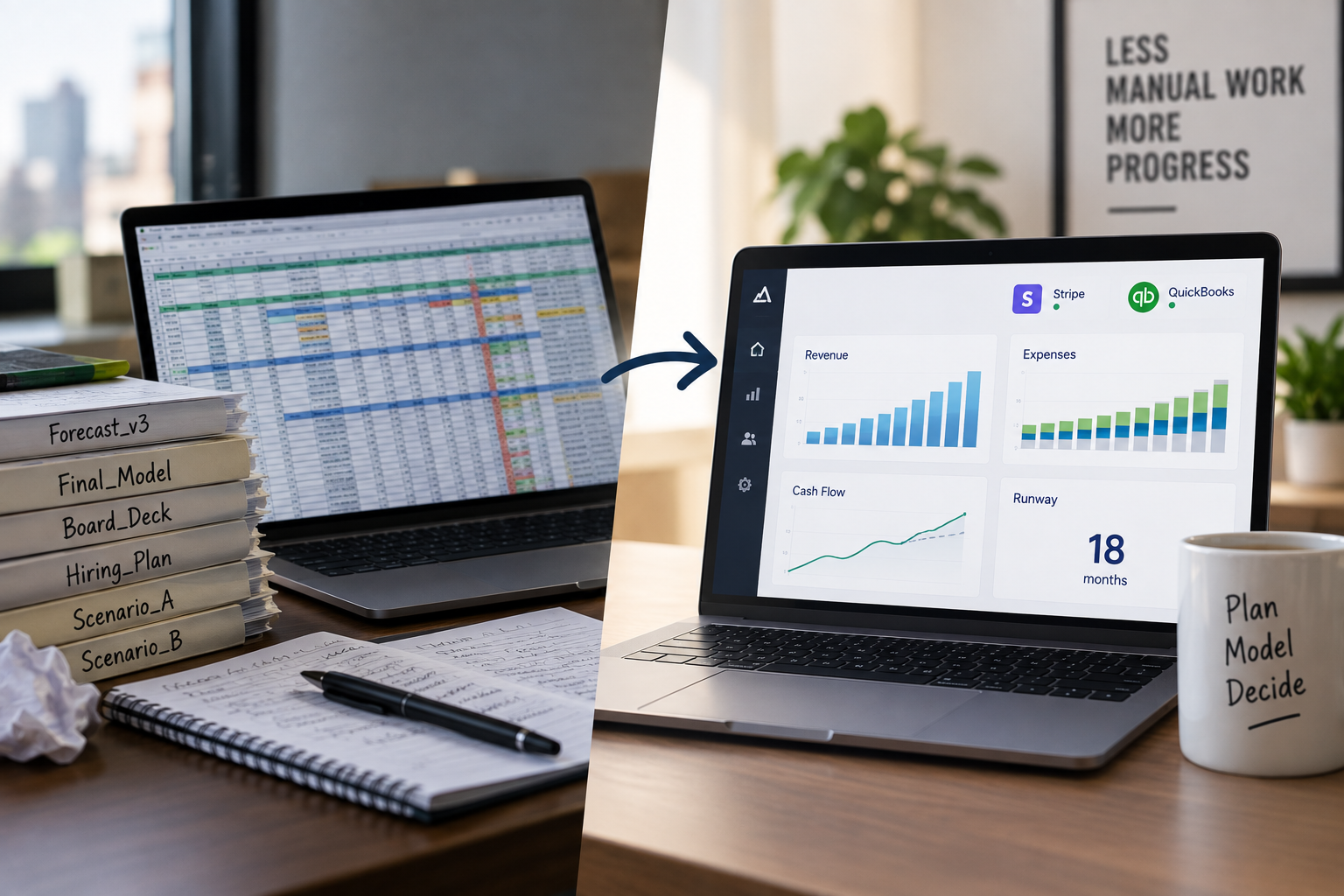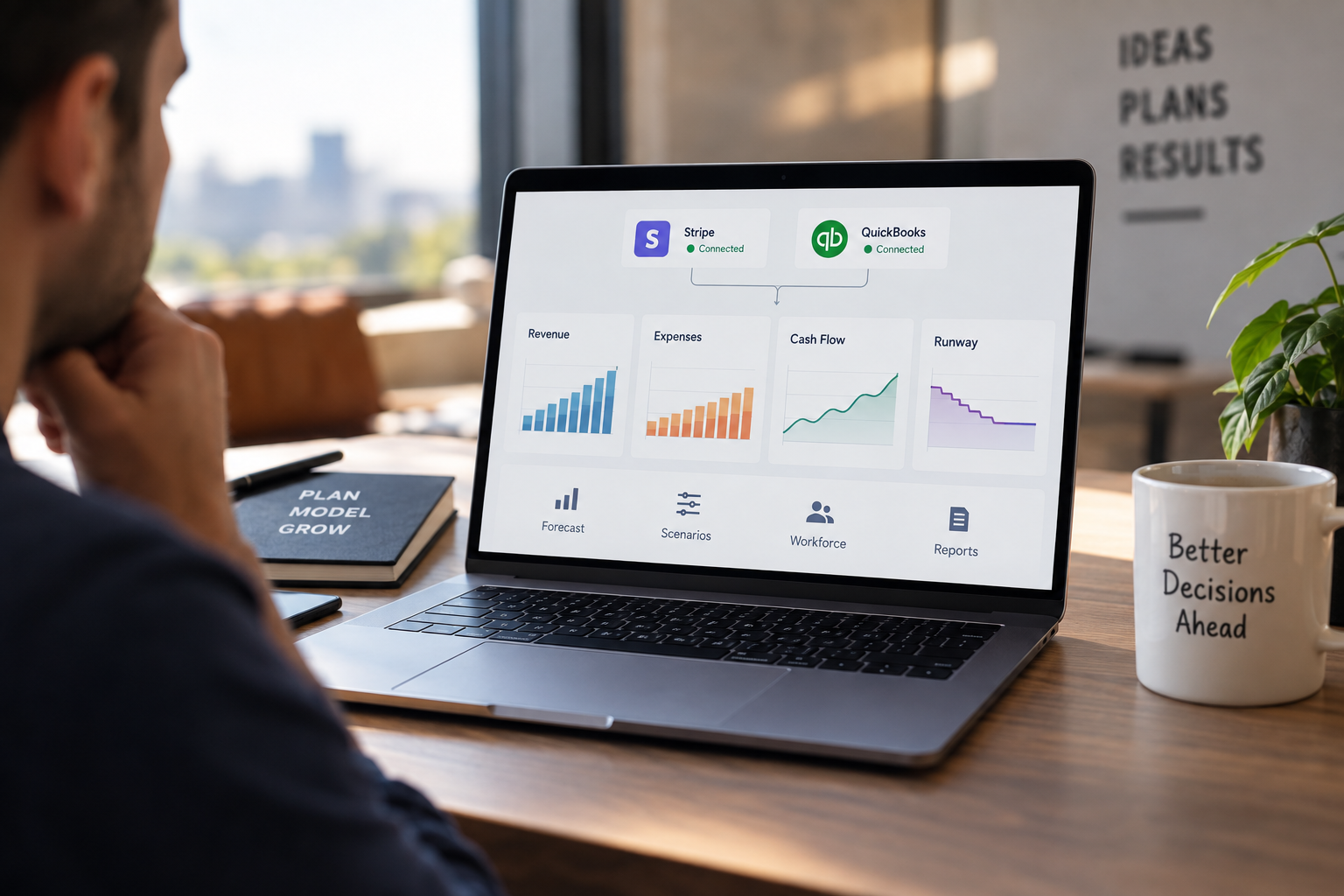
SaaS financial forecasting software should do more than display historical metrics.
It should help founders understand where the business may be heading and model how changes to subscriber growth, churn, pricing, hiring, spending, and financing could affect future revenue, profitability, cash flow, and runway.
For SaaS companies, that usually requires two types of data:
- Subscription and recurring revenue data from systems such as Stripe
- Broader financial and accounting data from systems such as QuickBooks Online
A SaaS forecasting platform that uses only subscription data may provide useful MRR and churn analytics but still miss payroll, operating expenses, debt, cash balances, and other financial information.
A platform that uses only accounting data may provide a broader financial picture but lack the subscription-level drivers that determine how recurring revenue evolves.
The strongest SaaS financial forecasting tools connect both.
RunSmart by Projection Genie is designed to combine Stripe subscription data with QuickBooks financial data, automatically establish a forward-looking baseline from historical performance, and allow founders to model the potential financial impact of future business decisions.
This guide explains what SaaS founders should look for when evaluating financial forecasting software.
What Is SaaS Financial Forecasting Software?
SaaS financial forecasting software helps companies estimate future financial performance using historical data, operating assumptions, or both.
Depending on the platform, it may forecast:
- MRR
- ARR
- Revenue
- Expenses
- Profitability
- Cash flow
- Cash balances
- Runway
- Balance sheet accounts
More advanced platforms may also support scenario modeling so founders can test how business decisions could change the financial outlook.
How Is SaaS Financial Forecasting Different From SaaS Analytics?
SaaS analytics primarily explains how the subscription business is performing.
Financial forecasting estimates where the business could be heading.
SaaS analytics may include:
- MRR
- ARR
- Churn
- NRR
- GRR
- ARPA
- Expansion
- Contraction
Financial forecasting may include:
- Future revenue
- Future expenses
- Profitability
- Cash flow
- Cash balances
- Runway
- Hiring costs
- Debt
- Financial statement forecasts
A founder usually needs both.
Why Isn't Stripe Analytics Alone Enough for Financial Forecasting?
Stripe provides valuable subscription and payment data, but it does not represent the complete financial picture of the company.
Stripe can help explain:
- Subscriber growth
- MRR
- Churn
- Expansion
- Contraction
- Pricing
- Billing
But SaaS founders also need to understand:
- Payroll
- Marketing expenses
- Software expenses
- Hosting
- Professional services
- Debt
- Taxes
- Cash balances
- Assets
- Liabilities
That broader financial information is typically found in the accounting system.
Why Isn't QuickBooks Alone Enough for SaaS Forecasting?
QuickBooks provides extensive accounting information, but it generally does not provide the same level of subscription behavior available from Stripe.
QuickBooks can show:
- Revenue
- Expenses
- Profitability
- Cash flow
- Assets
- Liabilities
- Debt
- Cash balances
But SaaS founders may also need to model:
- Subscriber growth
- Customer churn
- Revenue churn
- Expansion MRR
- Contraction MRR
- Pricing changes
- Subscription plan behavior
This is why combining QuickBooks and Stripe can produce a more useful SaaS financial forecast than relying on either system alone.
What Data Sources Should SaaS Forecasting Software Connect To?
At minimum, founders should consider whether the software connects to the systems that contain the most important financial and operating data.
For many SaaS companies, QuickBooks and Stripe provide the foundation.
As the company becomes more complex, payroll or HRIS data may also become important.
Should SaaS Forecasting Software Automatically Build a Baseline Forecast?
Ideally, yes.
A forecasting platform should reduce the amount of manual work required to establish the starting financial outlook.
A useful baseline forecast may analyze historical data to estimate how individual revenue and expense accounts could behave if current patterns continue.
That baseline then becomes the starting point for scenario modeling.
Without an automated baseline, founders may still need to manually build assumptions for every line item before they can begin planning.
Why Is an Automated Baseline Important?
A blank financial model forces the user to decide what every future number should be.
An automated baseline starts with the company's historical behavior.
For example, a platform may identify that:
- Revenue has been growing
- Payroll follows a relatively steady trend
- Marketing spending is volatile
- Software expenses are stable
- Certain costs are seasonal
Each account may require a different forecasting approach.
That is more useful than assuming every line item grows by the same percentage.
Should SaaS Forecasting Software Use One Forecasting Method for Everything?
Usually not.
Different financial accounts can behave differently.
Revenue may be seasonal.
Payroll may follow a trend.
Utilities may remain relatively stable.
Marketing may fluctuate significantly.
A forecasting system that applies one simplistic method to every account may produce weak results.
More sophisticated software can evaluate multiple forecasting methods and select the approach that best fits the historical behavior of each account.
What Should SaaS Scenario Modeling Allow You to Change?
Scenario modeling should allow founders to test the business assumptions that matter most.
For SaaS companies, this often includes:
- Subscriber growth
- Churn
- Expansion
- Contraction
- Pricing
- Hiring
- Compensation
- Marketing spending
- Other operating expenses
- Financing
- Loans
The software should then show how those changes affect the broader financial forecast.
Why Is Scenario Modeling Important?
A forecast answers:
Where could the business be heading?
Scenario modeling answers:
What could happen if we change something?
For example:
- What if churn rises from 2% to 4%?
- What if subscriber growth slows?
- What if we raise prices by 10%?
- What if the price increase causes more churn?
- What if we hire five employees?
- What if we delay those hires?
- What if marketing spending increases by 30%?
- What if financing arrives later than expected?
These are the questions founders actually face.
Should SaaS Forecasting Software Model MRR and the Financial Statements Together?
Yes.
MRR is important, but it does not represent the complete business.
A useful SaaS forecasting platform should connect recurring revenue assumptions to:
- Income statement
- Cash flow
- Balance sheet
For example, higher subscriber growth may increase MRR, but if the company also hires aggressively and spends more on marketing, cash flow could still deteriorate.
The value comes from seeing those effects together.
What Financial Statements Should SaaS Forecasting Software Support?
A complete financial forecasting system should ideally support all three primary financial statements:
- Income Statement
- Cash Flow Statement
- Balance Sheet
Each provides a different view.
The income statement shows profitability.
The cash flow statement shows how cash moves through the business.
The balance sheet shows financial position, including cash, assets, liabilities, and equity.
Why Is Cash Flow Forecasting Critical for SaaS Companies?
SaaS companies can grow quickly while still consuming cash.
A company can increase MRR and ARR while simultaneously:
- Hiring
- Increasing marketing spend
- Investing in product development
- Expanding infrastructure
- Taking on debt
That means revenue growth alone does not determine financial health.
A SaaS forecasting platform should show whether growth is improving or weakening future cash flow.
Should SaaS Forecasting Software Calculate Runway?
For companies that are burning cash, runway is one of the most important outputs.
A simplified runway formula is:
Runway = Available Cash ÷ Monthly Net Cash Burn
But a strong forecasting platform should go further than a static runway calculation.
It should project future cash balances month by month based on changing revenue and expenses.
This produces a dynamic runway forecast rather than assuming today's burn rate will remain constant forever.
Why Is Dynamic Runway Better Than Static Runway?
Static runway assumes monthly cash burn remains unchanged.
That is often unrealistic.
For example:
- Revenue may grow
- Churn may increase
- Employees may be hired
- Pricing may change
- Expenses may rise
- Financing may occur
A dynamic forecast incorporates these changes.
That allows founders to see not just today's runway, but how runway could change under different scenarios.
Should SaaS Forecasting Software Include Workforce Planning?
For many SaaS companies, yes.
Payroll is often one of the largest operating expenses.
Workforce planning should allow founders to model:
- Existing employees
- Planned hires
- Salaries
- Hourly wages
- Benefits
- Compensation increases
- Start dates
- End dates
Those assumptions should flow directly into the financial forecast.
What Workforce Metrics Can Be Useful?
SaaS founders may also want to evaluate workforce efficiency metrics such as:
- ARR per FTE
- Revenue per FTE
- Employee Cost % of Revenue
- Employee Cost % of OpEx
- Headcount Growth Rate
- Average Compensation per FTE
- Revenue Growth vs. Headcount Growth
These metrics help connect workforce growth with financial performance.
Should SaaS Forecasting Software Support Multiple Scenarios?
Yes.
A founder should be able to maintain more than one potential financial future.
Useful scenarios may include:
- Base case
- Best case
- Downside case
- Custom scenario
- Hiring scenario
- Pricing scenario
- Growth scenario
- Cost reduction scenario
The software should allow these scenarios to be compared without requiring separate spreadsheet models.
What Is the Difference Between Forecasting and Budgeting?
A forecast estimates future financial performance.
A budget establishes a financial plan or target.
The two are related but not identical.
A useful platform may allow a founder to turn an approved scenario into a budget and then compare actual results against that budget over time.
Why Is Budget vs. Actual Analysis Useful?
Budget vs. actual analysis shows how actual performance differs from the financial plan.
For example:
Budgeted Revenue = $150,000
Actual Revenue = $140,000
Variance:
-$10,000
The same analysis can be applied to:
- Expenses
- Profit
- Cash flow
- Other financial accounts
This helps founders see where actual performance is diverging from expectations.
What Should SaaS Founders Look for in Forecast Accuracy?
No forecasting software can predict the future perfectly.
The better question is whether the platform uses a disciplined methodology.
Founders should look for capabilities such as:
- Multiple forecasting models
- Historical validation
- Rolling-origin testing
- Forecast accuracy measurement
- Account-level model selection
- Forecastability indicators
A platform should also be transparent when historical data is insufficient or difficult to forecast reliably.
How Much Historical Data Should SaaS Forecasting Software Use?
More history can help identify trends and seasonality, but the exact amount needed depends on the forecasting method and the business.
A company with only a few months of history may still be able to analyze current financial performance, but statistical forecasting becomes less reliable with limited data.
Founders should understand whether the platform distinguishes between:
- Historical analysis
- Provisional forecasts
- More reliable forecasts based on longer history
Should Forecasts Update Automatically?
Ideally, yes.
As new actual financial data becomes available, the forecasting baseline should be updated.
This prevents the model from becoming increasingly disconnected from the company's actual performance.
For monthly financial planning, updating after the accounting period is closed can provide a cleaner basis than reacting to incomplete mid-month transactions.
Should SaaS Forecasting Software Support QuickBooks Refreshes?
If QuickBooks is a primary accounting source, the forecasting platform should allow updated financial data to be pulled into the model.
After a new month is closed and categorized, the updated data can become part of the historical record used for future analysis.
This helps keep the forecast anchored to actual financial performance.
Should SaaS Forecasting Software Be Easy for Non-Finance Founders to Use?
Yes.
Many SaaS founders understand their business deeply but are not trained financial modelers.
A forecasting tool should not require a founder to become an FP&A analyst just to answer basic business questions.
The software should ideally automate:
- Data import
- Historical analysis
- Forecast generation
- Financial statement linkage
- Scenario recalculation
The founder should be able to focus on the decisions being modeled.
How Does Spreadsheet-Based SaaS Forecasting Compare With Dedicated Software?
Spreadsheets can be flexible, but flexibility comes with maintenance.
For companies with simple needs, a spreadsheet may be sufficient.
As the number of assumptions, data sources, scenarios, and users increases, dedicated software can reduce manual maintenance.
What Are Common Problems With SaaS Financial Models in Spreadsheets?
Common issues include:
- Broken formulas
- Hard-coded assumptions
- Version confusion
- Manual data imports
- Duplicate scenario files
- Inconsistent formulas between scenarios
- Outdated actual results
- Difficult audit trails
- Time-consuming maintenance
These problems do not mean spreadsheets are inherently bad.
They mean the model becomes another system that someone must maintain.
Should SaaS Forecasting Software Replace a CFO?
Not necessarily.
Software and financial professionals serve different purposes.
Software can automate:
- Data collection
- Forecasting
- Scenario modeling
- Financial calculations
- Reporting
A CFO or financial advisor may provide:
- Strategic judgment
- Capital planning
- Board guidance
- Fundraising support
- Decision context
- Financial leadership
For earlier-stage companies, forecasting software can make sophisticated financial planning more accessible before the company needs or can justify a full-time CFO.
What Should Founders Compare When Evaluating SaaS Forecasting Tools?
A useful evaluation framework is to compare platforms across several dimensions.
The best choice depends on the company's complexity, data sources, financial planning needs, and internal resources.
Should SaaS Forecasting Software Support Stripe and QuickBooks Together?
For SaaS companies using both systems, this is a major advantage.
Stripe helps explain how the recurring revenue engine behaves.
QuickBooks provides the full financial context.
Together they can connect:
Subscriber Growth → MRR → Revenue → Expenses → Profitability → Cash Flow → Runway
That relationship is much more useful than analyzing either side independently.
What Questions Should Good SaaS Forecasting Software Help Answer?
A useful platform should help founders answer questions such as:
- Where could revenue be heading?
- What happens if subscriber growth slows?
- What happens if churn increases?
- What happens if churn improves?
- What happens if we raise prices?
- What happens if higher pricing increases churn?
- Can we afford to hire five employees?
- What happens if we delay those hires?
- What if marketing spending increases?
- What happens to profitability?
- What happens to cash flow?
- When could cash run out?
- How does the downside scenario compare with the baseline?
These questions are more useful than simply asking what happened last month.
How RunSmart Approaches SaaS Financial Forecasting
RunSmart by Projection Genie is designed to combine QuickBooks Online financial data with Stripe subscription data to create a forward-looking view of a SaaS business.
QuickBooks provides historical information about:
- Revenue
- Payroll
- Operating expenses
- Cash flow
- Cash balances
- Assets
- Liabilities
- Debt
Stripe provides information about:
- Subscribers
- MRR
- Churn
- Expansion
- Contraction
- Pricing
- Subscription growth
RunSmart automatically analyzes historical data and establishes a baseline forecast.
Instead of requiring every future assumption to be entered manually, RunSmart evaluates the historical behavior of individual financial statement accounts and uses forecasting methods suited to those patterns.
Founders can then model changes to:
- Subscriber growth
- Churn
- Expansion
- Contraction
- Pricing
- Hiring
- Spending
- Financing
- Other financial assumptions
The broader financial forecast is recalculated so founders can evaluate how those changes could affect:
- MRR
- Revenue
- Expenses
- Profitability
- Cash flow
- Financial health
- Cash balances
- Runway
How Does RunSmart Differ From a Historical SaaS Dashboard?
A SaaS dashboard primarily reports metrics.
RunSmart is designed to use those metrics as inputs into a forward-looking financial model.
For example, a dashboard may show:
Current churn = 3%
RunSmart can allow the founder to ask:
What happens to future revenue, profitability, cash flow, and runway if churn becomes 5%?
That distinction moves the analysis from reporting to scenario modeling.
How Does RunSmart Differ From a Blank Financial Model?
A blank financial model begins with assumptions that someone must create and maintain.
RunSmart begins with historical business data.
It automatically establishes a financial baseline and then allows founders to modify future assumptions.
This reduces the amount of model-building required before meaningful scenario analysis can begin.
SaaS Financial Forecasting Software Checklist
Before selecting a platform, founders can ask whether it supports the following capabilities:
Not every SaaS company needs every capability on day one.
But founders should understand whether the software can grow with the complexity of the business.
What Is the Best SaaS Financial Forecasting Software?
There is no single platform that is best for every SaaS company.
The right choice depends on factors such as:
- Company stage
- Financial complexity
- Accounting system
- Billing platform
- Number of entities
- Internal finance resources
- Need for scenario planning
- Reporting requirements
- Budget
- Desired level of automation
A company that primarily needs historical SaaS metrics may prefer a subscription analytics tool.
A company with a dedicated FP&A team may prefer a highly configurable enterprise planning system.
A founder who wants automated financial forecasting and scenario modeling using QuickBooks and Stripe may prefer a platform designed around that workflow.
Frequently Asked Questions
What is SaaS financial forecasting software?
SaaS financial forecasting software estimates future financial performance using historical data and business assumptions. It may forecast revenue, expenses, profitability, cash flow, cash balances, runway, and financial statements.
Is SaaS forecasting software the same as SaaS analytics software?
No. SaaS analytics primarily reports metrics such as MRR, ARR, churn, and NRR. Financial forecasting estimates future financial outcomes and may connect those SaaS metrics to expenses, profitability, cash flow, and runway.
Should SaaS forecasting software integrate with Stripe?
For SaaS companies using Stripe, integration can provide valuable subscription-level information about customers, MRR, churn, expansion, contraction, and pricing.
Should SaaS forecasting software integrate with QuickBooks?
For companies using QuickBooks, integration provides broader financial information including revenue, expenses, payroll, profitability, cash flow, cash balances, assets, liabilities, and debt.
Why use Stripe and QuickBooks together for forecasting?
Stripe explains the recurring revenue engine while QuickBooks provides the broader financial picture. Combining them helps connect changes in subscriber behavior with profitability, cash flow, and runway.
Should SaaS forecasting software model churn?
Yes. Churn can materially affect future subscribers, MRR, revenue, cash flow, and runway.
Should SaaS forecasting software support pricing scenarios?
Yes. Pricing changes can affect recurring revenue, churn, subscriber growth, profitability, and cash flow.
Should SaaS forecasting software support hiring plans?
Yes. Hiring can materially change payroll, expenses, cash flow, and runway.
Should SaaS forecasting software forecast runway?
For companies burning cash, runway forecasting is valuable. Dynamic runway forecasting is generally more useful than dividing current cash by today's burn rate because future revenue and expenses can change.
Can SaaS financial forecasting software replace spreadsheets?
It can reduce reliance on spreadsheets by automating data connections, forecasting, scenario modeling, and financial calculations. Some companies may still use spreadsheets for specialized analysis.
Can RunSmart forecast SaaS financial performance?
Yes. RunSmart combines QuickBooks Online financial data with Stripe subscription data to establish a financial baseline and model future changes to SaaS and financial assumptions.
Can RunSmart model subscriber growth, churn, pricing, and hiring together?
Yes. These assumptions can be modeled within broader financial scenarios so founders can evaluate their potential impact on revenue, profitability, cash flow, and runway.
Does RunSmart require founders to build a financial model from scratch?
No. RunSmart is designed to automatically establish the baseline financial forecast from historical data so founders can focus on the assumptions and decisions they want to model.
The Best SaaS Forecasting Software Should Connect Operating Decisions to Financial Outcomes
SaaS founders do not make decisions one financial statement at a time.
They decide whether to:
- Hire
- Raise prices
- Spend more on growth
- Reduce churn
- Expand the team
- Take on financing
- Change strategy
Those decisions affect multiple parts of the business simultaneously.
That is why useful SaaS financial forecasting software should do more than display historical metrics or extrapolate revenue.
It should connect subscription behavior, operating expenses, financial statements, cash flow, and runway in one forward-looking model.
For founders using Stripe and QuickBooks, the goal is simple:
Understand where the business may be heading, then model how the decisions being considered could change that financial future before committing to them.