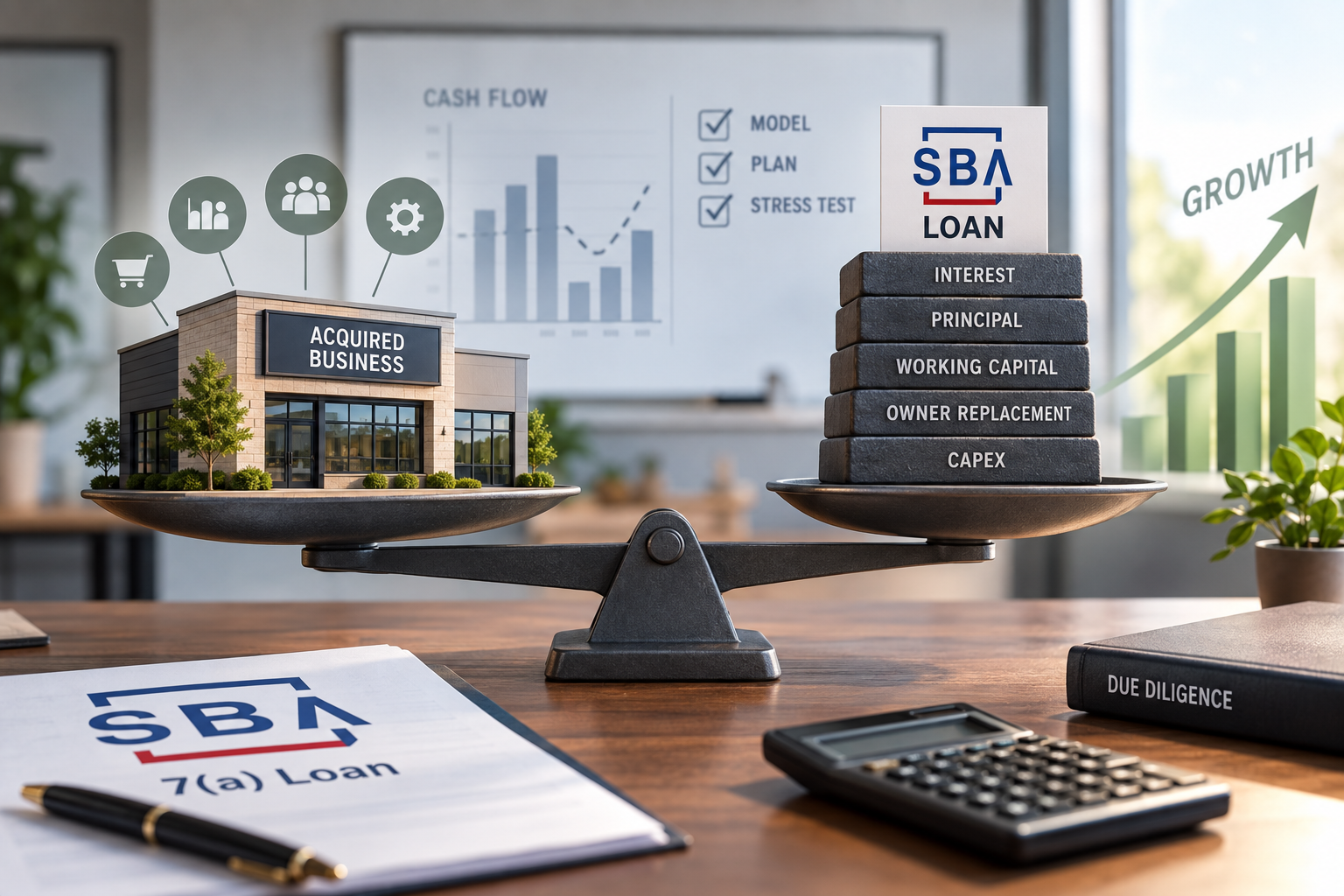
When buying a business with an SBA loan, financial modeling can help you understand whether the company may be able to support its operating expenses, working-capital needs, investments, and new acquisition debt after ownership changes.
An SBA-backed loan can make it possible to acquire a business without paying the entire purchase price in cash.
But financing the acquisition and understanding its economics are two different questions.
A business might have generated attractive profits for its current owner while carrying relatively little debt.
After the acquisition, that same company may need to support a large loan, interest expense, principal payments, new owner compensation, management hires, and other changes.
The historical business and the post-acquisition business are therefore not necessarily financially identical.
That's why a prospective buyer should look beyond:
"Can I get financing for this acquisition?"
and also ask:
"What does this business look like financially after I add the financing?"
This guide explains how to model an SBA-financed business acquisition and evaluate how debt, operating performance, working capital, staffing, and other assumptions could affect the company after closing.
Key Takeaways
- SBA 7(a) loans can be used for qualifying complete or partial changes of business ownership.
- SBA doesn't directly make the 7(a) loan to the buyer. Participating lenders make the loan, with SBA providing a guaranty subject to program requirements.
- The seller's historical financial statements may not reflect the company's post-acquisition debt structure.
- Model both interest and principal obligations because they affect the acquisition differently from an accounting and cash-flow perspective.
- Don't evaluate debt service independently from payroll, working capital, capital expenditures, taxes, and other demands on cash.
- Build projections for the business after ownership changes rather than simply extending the seller's historical results.
- Test multiple operating conditions to understand how weaker revenue, margins, or cash collections could affect the company's ability to support its obligations.
- Financial modeling can help you understand the acquisition, but your lender determines its underwriting requirements and whether financing is approved.
Can You Use an SBA Loan to Buy a Business?
Yes. The SBA's 7(a) loan program permits loan proceeds to be used for qualifying changes of ownership, including complete and partial changes of ownership.
The 7(a) program is the SBA's primary business loan program.
The SBA doesn't generally lend the money directly to the acquisition entrepreneur. Instead, participating lenders make loans subject to SBA program requirements, and the SBA guarantees a portion of eligible loans.
As of 2026, most 7(a) loans can be as large as $5 million, although the amount available for a particular acquisition depends on the transaction, borrower, business, lender, eligibility requirements, and applicable SBA rules.
Interest rates are negotiated between the borrower and lender subject to SBA maximums, and rates may be fixed or variable.
Because SBA requirements and lending policies can change, prospective buyers should confirm current requirements with the SBA and participating lenders rather than relying on old acquisition guides or assumptions.
Why Are SBA Loans Commonly Considered for Business Acquisitions?
Buying an established business can require substantially more capital than many individual entrepreneurs have available in cash.
Financing can allow a buyer to combine their own investment with borrowed capital rather than funding the entire transaction themselves.
For an acquisition entrepreneur, this can make a larger acquisition financially possible.
But debt also changes the economics of the business.
Before the acquisition, the company might have:
- Minimal debt
- Limited interest expense
- No acquisition loan
- A particular owner compensation structure
After the acquisition, it could have:
- Acquisition debt
- Interest expense
- Required principal payments
- New owner compensation
- Replacement management costs
- Additional professional expenses
- Different working-capital requirements
Those changes need to be incorporated into the buyer's financial analysis.
Don't Confuse the SBA Guarantee With a Guarantee to the Buyer
The phrase "SBA-guaranteed loan" can sometimes create confusion.
The SBA guaranty is primarily a guaranty provided to the participating lender on an eligible portion of the loan.
It doesn't mean the SBA guarantees that:
- The acquisition will succeed
- The business will generate enough cash
- The buyer won't experience losses
- The borrower won't be responsible for repayment
From the buyer's perspective, this is still debt.
The business and borrower must operate within the financing structure after closing.
That's why acquisition modeling matters.
Start With the Business's Historical Financial Performance
Before adding acquisition financing, understand the underlying business.
Review multiple years of historical information where available, including:
- Revenue
- Gross profit
- Operating expenses
- Payroll
- Operating income
- Cash flow
- Accounts receivable
- Accounts payable
- Inventory
- Existing debt
- Assets and liabilities
- Capital expenditures
You're trying to establish the company's underlying financial characteristics before layering acquisition financing on top of them.
Ask:
Is revenue growing, stable, or declining?
Are margins stable?
How consistently does the company generate cash?
How much working capital does it require?
Does it need regular capital expenditures?
Are customers paying consistently?
How much financial flexibility does it currently have?
The stronger your understanding of the underlying business, the more meaningful your acquisition model becomes.
Build the Business You Expect to Own
One of the most important mistakes to avoid is simply taking the seller's historical Profit and Loss Statement and adding loan payments.
Ownership changes may affect much more than financing.
Consider whether you will need to change:
- Owner compensation
- Management
- Staffing
- Employee compensation
- Benefits
- Marketing
- Insurance
- Professional services
- Technology
- Rent
- Capital expenditures
- Other operating costs
Suppose the seller currently manages the company full time.
If you intend to hire a $140,000 general manager instead of performing that role yourself, that cost should be reflected in your post-acquisition model.
The question isn't:
"What did this business earn for the seller?"
It's:
"What might this business earn under my ownership structure?"
How Should You Model the SBA Acquisition Loan?
Once you've established the operating forecast, incorporate the proposed financing.
At a minimum, understand:
- Loan amount
- Interest rate
- Whether the rate is fixed or variable
- Repayment period
- Estimated principal payments
- Estimated interest expense
- Applicable loan fees
- Other debt in the capital structure
- Seller financing, if applicable
The exact financing structure should come from your lender and transaction documents.
Don't build the model around assumptions about loan terms that haven't been confirmed.
Interest and Principal Affect the Business Differently
This distinction is particularly important.
Interest expense generally affects profitability on the Profit and Loss Statement.
Loan principal repayment generally doesn't appear as an ordinary expense on the Profit and Loss Statement, but it still uses cash.
That means looking only at projected net income can overstate the amount of cash available after financing obligations.
Consider a simplified example.
Suppose the post-acquisition business produces:
$450,000 of cash available before acquisition debt service
and annual acquisition financing requires:
- $180,000 of principal
- $120,000 of interest
Total annual debt service would be:
$300,000
That would leave:
$150,000 before considering other cash requirements not already incorporated into the calculation.
Those other requirements could include:
- Additional working capital
- Capital expenditures
- Taxes
- Other debt
- Unexpected operating needs
The exact accounting and cash-flow treatment depends on the transaction, but the principle is important:
Profit isn't the same as cash available to service acquisition debt.
What Is Debt Service?
Debt service generally refers to the principal and interest payments required on debt during a period.
For an acquisition entrepreneur, understanding debt service helps answer:
How much cash must the business produce simply to satisfy its financing obligations?
Suppose an acquisition loan requires $25,000 per month of principal and interest.
That's:
$300,000 per year.
Those payments continue regardless of whether revenue meets your forecast.
This creates a fixed financial obligation that didn't necessarily exist under the seller's ownership.
What Is Debt Service Coverage?
One measure lenders and buyers may use when evaluating debt capacity is the Debt Service Coverage Ratio (DSCR).
A simplified conceptual formulation is:
Cash Flow Available for Debt Service ÷ Required Debt Service
For example, if a business has $450,000 available for debt service and requires $300,000 of annual debt service:
$450,000 ÷ $300,000 = 1.50x
Conceptually, this means the modeled cash available for debt service is 1.5 times the modeled debt-service requirement.
However, buyers should be careful when comparing DSCR calculations.
Different lenders, transactions, and analyses may define the numerator differently.
Your lender's underwriting calculation and required coverage threshold are what matter for the actual financing decision.
Financial modeling should therefore complement lender underwriting rather than attempt to replace it.
Don't Model Debt Service in Isolation
A company doesn't exist solely to make loan payments.
It also needs cash to operate.
The acquisition model should consider competing uses of cash such as:
- Payroll
- Inventory
- Accounts receivable
- Supplier payments
- Taxes
- Capital expenditures
- Repairs
- Marketing
- Owner compensation
- Unexpected expenses
A business may technically generate enough cash to cover debt payments while leaving very little financial flexibility afterward.
That's different from an acquisition that can support debt while also maintaining adequate liquidity and reinvesting in the company.
Why Does Working Capital Matter in an SBA-Financed Acquisition?
Working capital can materially change how much cash the business needs after closing.
Consider a company where customers typically pay 45 days after receiving an invoice.
Employees might be paid every two weeks.
Suppliers may need to be paid within 30 days.
The company needs enough cash to bridge those timing differences.
Growth can increase that requirement.
If sales rise, the company may need:
- More inventory
- More employees
- More supplier purchases
- More receivables financing
before collecting the additional customer revenue.
That's why a profitable growth forecast can still create cash pressure.
A buyer should understand not only whether the acquisition can be financed, but also whether the business will have enough working capital to operate after closing.
Don't Forget Capital Expenditures
The seller's recent financial statements may show strong cash generation.
But ask whether the business has continued investing adequately in its assets.
Does it need:
- Vehicles?
- Machinery?
- Computers?
- Building improvements?
- Production equipment?
- Technology infrastructure?
Suppose the company requires $150,000 of equipment during the first year after closing.
That cash requirement competes with acquisition debt service.
If the expenditure is financed instead, it could create additional financial obligations.
This is another reason acquisition analysis should extend beyond historical EBITDA or net income.
Build an Integrated Post-Acquisition Forecast
A useful SBA acquisition model should ideally show the interaction between the projected:
- Profit and Loss Statement
- Cash Flow Statement
- Balance Sheet
Why?
Because acquisition financing affects all three differently.
Borrowing creates a liability.
Interest affects profitability.
Principal repayment reduces cash and debt.
Working-capital changes affect cash and Balance Sheet accounts.
Capital expenditures use cash while creating assets.
An integrated forecast helps you understand these relationships instead of evaluating each financial statement independently.
Example: Modeling an SBA-Financed Business Acquisition
Consider a simplified example.
Assume a business historically generates:
- Revenue: $3,500,000
- Gross Profit: $1,400,000
- Operating Expenses: $850,000
- Operating Income: $550,000
At first glance, $550,000 of operating income may look attractive.
But your post-acquisition structure introduces:
- General manager: $140,000
- Additional insurance and professional expenses: $30,000
- Acquisition loan interest: $110,000
Before considering taxes and other changes, those items reduce modeled earnings substantially.
You also expect:
- Acquisition loan principal payments: $160,000
- Additional working-capital requirement: $50,000
- Equipment purchase: $60,000
Those last three items create additional cash demands that aren't simply operating expenses on the Profit and Loss Statement.
This is why asking whether the business historically generated $550,000 of operating income isn't enough.
The more useful question is:
How much financial flexibility remains after the business is operating under my ownership and financing structure?
What Happens if Revenue Doesn't Meet the Forecast?
Once you've modeled the expected acquisition, stress-test it.
Suppose your Base forecast assumes $3.5 million of revenue.
What happens at:
$3.325 million?
A 5% decline.
$3.15 million?
A 10% decline.
$2.975 million?
A 15% decline.
Then examine how the changes affect:
- Gross profit
- Operating income
- Cash flow
- Liquidity
- Debt coverage
- Ending cash
Debt payments generally don't fall simply because revenue declines.
That's what makes leverage important in downside analysis.
What Happens if Margins Decline?
Revenue can remain stable while profitability deteriorates.
Suppose $3.5 million of revenue produces a 40% gross margin.
Gross profit is:
$1.4 million
If gross margin falls to 36%, gross profit becomes:
$1.26 million
That's $140,000 less gross profit without any decline in revenue.
If the acquisition already has substantial fixed debt obligations, margin compression can materially reduce the financial cushion.
What Happens if Customers Pay More Slowly?
A business can remain profitable while experiencing cash pressure.
Suppose customer payment times increase substantially after the acquisition.
Accounts Receivable increases.
Cash becomes tied up.
But debt payments remain due.
This is why acquisition modeling should examine Balance Sheet and cash-flow behavior rather than focusing exclusively on projected profit.
What Happens if Interest Rates Change?
If your proposed financing uses a variable interest rate, changes in the underlying rate can affect future interest expense and debt service.
SBA permits both fixed and variable interest rates for 7(a) loans, subject to program requirements.
If you're considering variable-rate financing, model more than one rate assumption.
Ask:
What happens to cash flow if the rate increases?
How much additional annual debt service would that create?
Would the business still maintain adequate liquidity?
Use the actual terms provided by your lender when modeling these scenarios.
How Can RunSmart Help Model an SBA-Financed Acquisition?
Building an acquisition model manually often requires importing historical financial data into spreadsheets, constructing forecasts, adding post-acquisition assumptions, and maintaining formulas across multiple financial statements.
RunSmart by Projection Genie connects to QuickBooks Online and automatically transforms historical accounting data into forward-looking financial forecasts.
For a prospective acquisition, the buyer can use the historical business as the starting point and then model changes such as:
- Revenue assumptions
- Operating expenses
- Hiring
- Compensation
- Other post-acquisition changes
RunSmart also supports Bull, Base, Bear, and Custom forecast models and allows users to create multiple scenarios.
This makes it possible to evaluate the business under different financial outlooks rather than relying on one expected forecast.
For example:
Base Forecast + Post-Acquisition Management Costs
Bear Forecast + Post-Acquisition Management Costs
Base Forecast + Higher Operating Expenses
Bear Forecast + Higher Operating Expenses
The purpose is to understand how the business may perform under the buyer's assumptions before those assumptions become actual operating decisions.
Use the Financing Terms Your Lender Provides
RunSmart can help model the business's future financial performance, but SBA loan approval and underwriting remain the responsibility of participating lenders and the SBA program.
Your lender may have specific requirements for:
- Cash-flow calculations
- Debt-service coverage
- Equity contribution
- Collateral
- Personal guarantees
- Business valuation
- Financial projections
- Supporting documentation
- Transaction structure
Those requirements can also change as SBA policies change.
Use lender-provided financing terms and requirements in your acquisition analysis rather than assuming that a generic online example applies to your transaction.
Model More Than the Lender's Minimum Case
Lender approval answers an important question:
Will the lender make this loan under its underwriting requirements?
Your personal acquisition analysis can ask additional questions.
For example:
What happens if revenue declines after I buy the business?
Can the company afford the manager I expect to hire?
What if margins deteriorate?
How much cash remains after debt service?
What happens if I need $100,000 of equipment?
Can the company support growth without creating a working-capital shortage?
What happens under a Bear forecast?
These questions aren't substitutes for lender underwriting.
They're questions about the company you're preparing to own.
Don't Assume Loan Approval Makes the Acquisition Financially Comfortable
A lender and a buyer approach a transaction from different perspectives.
The lender evaluates whether the proposed loan satisfies its credit and program requirements.
The buyer needs to live with the economics of the acquisition afterward.
Your objectives may include:
- Paying yourself
- Hiring employees
- Investing in growth
- Maintaining adequate cash reserves
- Replacing equipment
- Withstanding downturns
- Eventually expanding the company
A business could potentially satisfy financing requirements while still leaving less financial flexibility than you personally want.
That's why your acquisition model should reflect your plans for the company, not simply the requirements necessary to obtain financing.
Turn the Acquisition Model Into an Operating Plan
The model can remain useful after the transaction closes.
Suppose your acquisition forecast assumed:
- $3.5 million revenue
- 40% gross margin
- $900,000 payroll
- $250,000 ending cash
Six months after closing, you can compare actual results with those expectations.
Is revenue ahead or behind?
Are margins tracking according to plan?
Is payroll higher?
Is cash lower?
Are customers paying more slowly?
Are debt obligations creating the cash pressure you expected?
RunSmart allows a scenario to be converted into a budget so actual financial performance can be compared against the plan.
That creates a useful progression:
Historical QuickBooks data → Acquisition forecast → Financing assumptions → Operating scenario → Budget → Actual performance
The acquisition model becomes more than something created for the transaction.
It can become part of how you manage the business.
Financing the Acquisition Is Only the Beginning
SBA financing can help make acquiring an established business possible.
But obtaining financing doesn't answer every financial question surrounding the acquisition.
You still need to understand:
- How the company generates cash
- How ownership changes affect expenses
- How much working capital the business needs
- How acquisition debt changes the financial structure
- How much cash remains after required obligations
- What investments may be required after closing
- What happens when performance doesn't meet expectations
Historical financial statements provide the starting point.
The financing structure tells you how the acquisition may be funded.
Financial modeling connects those pieces and helps you understand the business you may actually own.
If the company you're evaluating uses QuickBooks Online, RunSmart by Projection Genie can help you automatically analyze its historical financial data, generate forward-looking forecasts, and model different assumptions and scenarios to understand how the business could perform after the acquisition.
Learn more about how RunSmart can help you model a business acquisition before you commit.
Frequently Asked Questions About Buying a Business With an SBA Loan
Can an SBA 7(a) loan be used to buy an existing business?
Yes. SBA 7(a) loan proceeds can be used for qualifying complete or partial changes of business ownership.
Eligibility and financing depend on the business, borrower, transaction, lender, and current SBA program requirements.
Does the SBA lend money directly to someone buying a business?
Generally, no. Participating lenders make 7(a) loans, while the SBA provides a guaranty on an eligible portion of the loan.
The borrower remains responsible for the loan according to the applicable financing agreements.
What is the maximum SBA 7(a) loan amount?
As of 2026, most 7(a) loans have a maximum loan amount of $5 million.
Other SBA loan programs and delivery methods can have different limits, so buyers should confirm the current rules applicable to their transaction.
What financial information should you model when using an SBA loan to buy a business?
An acquisition model may include projected revenue, gross margin, payroll, operating expenses, owner compensation, acquisition debt, interest, principal payments, working capital, capital expenditures, taxes, assets, liabilities, and cash flow.
The objective is to understand the post-acquisition business rather than relying only on the seller's historical results.
What is debt service in a business acquisition?
Debt service generally refers to the principal and interest payments required on debt during a period.
For an acquisition buyer, debt service represents a recurring use of cash that should be incorporated into the post-acquisition financial model.
What is DSCR when buying a business?
Debt Service Coverage Ratio, or DSCR, compares cash available for debt service with required debt-service obligations.
The exact calculation and required threshold can vary depending on the lender and transaction, so buyers should use the methodology required by their lender when evaluating SBA financing.
Should acquisition loan principal payments appear as an expense in the forecast?
Loan principal generally isn't treated as an ordinary expense on the Profit and Loss Statement.
However, principal repayment still uses cash and therefore needs to be considered in cash-flow projections.
Interest expense and principal repayment affect the financial statements differently.
Why should you stress test an SBA-financed acquisition?
Acquisition debt creates financial obligations that generally remain even when business performance weakens.
Stress testing can help a buyer understand what happens to profitability, cash flow, liquidity, and debt coverage if revenue falls, margins decline, expenses rise, customers pay more slowly, or other assumptions change.
Can RunSmart model a business being purchased with an SBA loan?
RunSmart by Projection Genie connects to QuickBooks Online and automatically generates forward-looking financial forecasts from historical accounting data.
Acquisition entrepreneurs can use RunSmart's forecast models and scenarios to evaluate how different operating assumptions may affect future profitability, cash flow, and financial position when analyzing an acquisition.
Specific SBA loan terms and lender underwriting requirements should come directly from the buyer's lender and be incorporated appropriately into the acquisition analysis.
Does SBA loan approval mean a business is a good acquisition?
Loan approval and the buyer's acquisition decision are different questions.
A buyer may also consider valuation, future financial performance, cash flow, operating risks, customers, employees, industry conditions, legal matters, taxes, personal objectives, and many other factors.
Financial projections and stress testing can provide additional information for that decision, but they don't determine whether an acquisition should be completed.