Creating financial projections is one of the most important parts of building a business plan.
Your business idea may sound promising, but financial projections help you translate that idea into numbers. They can help you estimate how much money you'll need to get started, how much revenue the business might generate, what it will cost to operate, when you could become profitable, and whether you may have enough cash to keep the business running.
Financial projections are also commonly requested when seeking financing because lenders and other stakeholders may want to understand the financial assumptions behind your business plan.
The challenge is that many aspiring business owners don't know how to build financial models or complicated spreadsheets.
Fortunately, you don't necessarily need either.
What Are Financial Projections in a Business Plan?
Financial projections estimate how your business may perform financially based on assumptions about sales, pricing, expenses, staffing, financing, and other factors.
Unlike historical financial statements, which show what has already happened, projections look forward.
For a new business without historical financial results, projections are particularly important because much of your financial plan must be built around assumptions about how the business will operate.
The goal isn't to predict the future perfectly. It's to develop reasonable assumptions and understand what those assumptions could mean financially.
What Financial Projections Should a Business Plan Include?
The exact requirements will depend on why you're creating the business plan, but a complete set of projections will typically include several important components.
Projected Income Statement
A projected income statement estimates revenue, cost of goods sold when applicable, operating expenses, and profit over a future period.
This helps answer one of the most fundamental questions about your business idea:
Can the business generate enough revenue to cover its expenses and eventually become profitable?
Projected Cash Flow Statement
Profit and cash are not the same thing.
A projected cash flow statement helps estimate when money may enter and leave the business and whether you could encounter periods when available cash becomes tight.
This can be especially important during the first months of operation when expenses may begin before the business reaches its expected sales volume.
Projected Balance Sheet
A projected balance sheet estimates what the business may own, what it may owe, and the owner's equity at different points in the forecast.
Together, the projected income statement, cash flow statement, and balance sheet provide a more complete picture of the expected financial position of the business.
Step 1: Estimate Your Startup Costs
Start by identifying what you'll need to spend before opening your doors or making your first sale.
Depending on the business, startup costs might include equipment, inventory, deposits, licenses, professional fees, furniture, technology, initial marketing, renovations, and other one-time expenses.
You should also think about working capital.
Even after the business launches, you may need enough cash to cover payroll, rent, inventory, marketing, loan payments, and other expenses while sales are still ramping up.
Underestimating startup costs can leave a business underfunded before it has had enough time to establish itself.
Step 2: Build Your Revenue Assumptions
Next, estimate how the business will generate revenue.
Instead of simply choosing an annual sales number, break your forecast into assumptions you can explain.
Depending on your business model, that might include:
- Number of customers
- Number of transactions
- Average selling price
- Units sold
- Customer growth
- Recurring revenue
- Seasonal changes
- Capacity limitations
For example, a service business might estimate the number of customers it can serve each month and the average amount charged per customer.
A retail business might estimate transactions and average order value.
The more clearly you can connect projected revenue to understandable business assumptions, the easier it becomes to evaluate whether your forecast is realistic.
Step 3: Estimate Your Expenses
Identify the expenses required to operate the business.
These may include rent, payroll, benefits, insurance, utilities, software, advertising, professional services, supplies, and other operating costs.
Some expenses may remain relatively stable each month. Others may increase as sales grow.
Make sure you also consider expenses that are easy to overlook, including payroll taxes, payment processing fees, maintenance, insurance increases, and other costs associated with growth.
Step 4: Include Hiring and Staffing Plans
If your business will have employees, incorporate your hiring assumptions into the projections.
Consider when each employee will start, their salary or hourly wage, expected hours, benefits, payroll-related costs, and future compensation increases.
Timing matters.
Hiring three employees immediately can have a very different effect on cash flow than hiring those employees gradually as the business grows.
Step 5: Account for Business Financing
If you're using a loan to fund the business, your projections should reflect the financing.
That includes the amount borrowed, interest rate, repayment term, and expected payments.
You should also clearly identify how much money you're personally contributing and how the available funds will be used.
A sources and uses of funds schedule can help organize this information.
Step 6: Calculate Your Break-Even Point
Break-even analysis helps estimate how much revenue your business needs to generate to cover its costs.
This is useful because it turns profitability into a more practical question:
How much do I actually need to sell before the business can support its expenses?
If your projected sales are barely above break-even, you may have little room for error.
If break-even requires a sales volume that appears unrealistic, you may need to reconsider your pricing, expenses, or other assumptions.
Step 7: Review Your Cash Needs
One of the biggest reasons to create projections before launching is to understand whether the business may run short of cash.
Review your projected cash balance throughout the forecast.
If cash becomes negative, that doesn't necessarily mean the business idea can't work. It may indicate that you need more startup capital, slower hiring, lower expenses, different financing, or stronger early sales.
It's much better to identify that potential problem while planning the business than after you've already committed your money.
Can You Create Business Plan Financial Projections for Free?
Yes.
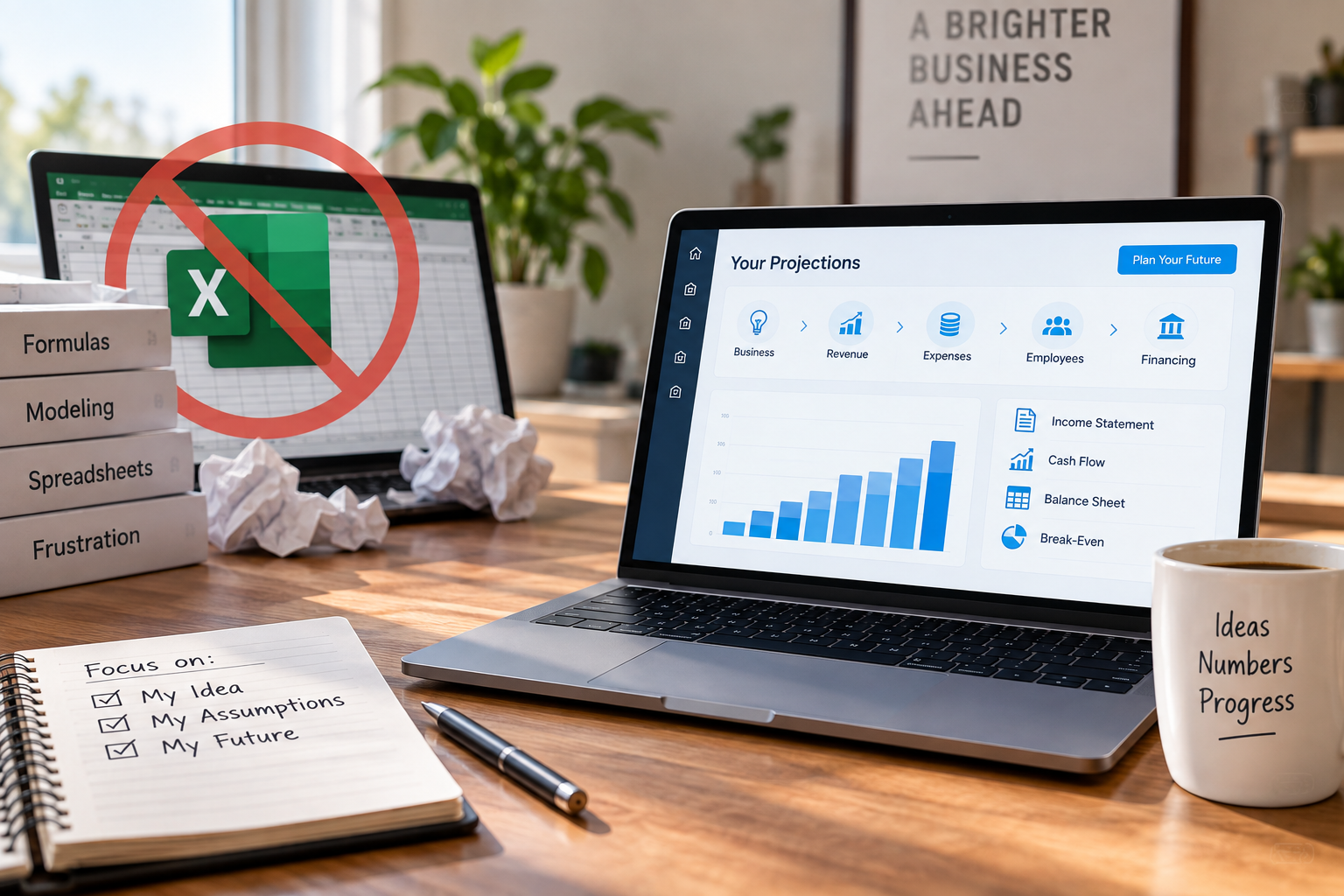
You can build projections manually using spreadsheet software, but you'll need to create the formulas, connect the financial statements, and make sure changes to your assumptions flow through the model correctly.
Another option is to use financial planning software that automates much of the process.
StartSmart lets you answer guided questions about your business idea and planning assumptions and automatically turns those answers into a complete financial plan, projections, and supporting documentation.
You can use StartSmart to plan one business completely free.
There are no spreadsheets or financial models to build, and you don't need financial modeling experience to get started.
Create Your Business Plan Financial Projections for Free
Financial projections can help you move beyond whether a business idea sounds good and begin evaluating whether the numbers behind it make sense.
By estimating startup costs, revenue, expenses, staffing, financing, profitability, and cash flow before launch, you can better understand what your business may need to succeed and identify potential financial challenges earlier.
StartSmart can do the financial modeling and calculations for you while helping you organize the assumptions behind your plan.
Create your financial projections and complete financial plan for one business completely free with StartSmart.