Many CPAs and bookkeepers want to offer advisory services.
Yet far fewer actually do.
Not because they don't see the value.
Not because clients don't need guidance.
But because many professionals feel they need to have everything figured out before they begin.
Questions naturally arise:
- How do we build forecasts?
- Which KPIs should we track?
- How do we identify financial risks?
- How do we create client-ready reports?
- How do we scale this across multiple clients?
Before long, many firms find themselves spending so much time trying to define the perfect advisory process that they never actually get started.
The reality is that a firm's first advisory service doesn't need to be perfect.
It simply needs to provide enough value to create better conversations with clients.
The Biggest Misconception About Advisory Services
One of the most common misconceptions about advisory services is that firms need to become fractional CFOs overnight.
They don't.
In many cases, the first step into advisory can be much simpler.
Rather than attempting to build a comprehensive advisory offering from day one, firms can start by providing a few additional insights after month-end close for a handful of clients.
For example:
- Revenue has declined for three consecutive months.
- Gross margin has fallen compared to last quarter.
- Operating expenses are growing faster than revenue.
- Accounts receivable has increased significantly over the past six months.
- Net income has declined despite higher sales.
These aren't recommendations.
They're observations.
Observations create questions, and questions are often where advisory relationships naturally begin.
Many business owners don't realize these trends exist until someone points them out.
Firms don't need to launch a full advisory offering and overwhelm themselves.
They can start by helping clients better understand what their numbers are telling them, one observation at a time.
Then build from there.
The Next Challenge: Scale
Once firms begin considering advisory services, another concern quickly emerges.
Scale.
Helping one client better understand their numbers is manageable.
Helping ten, twenty, or thirty clients is a completely different challenge.
As more clients begin asking for the same level of guidance, it often means:
- More spreadsheet updates
- More forecast maintenance
- More KPI calculations
- More report preparation
- More client communications
This is where many professionals begin to worry that advisory services may quickly overwhelm them.
And it's a valid concern.
The key isn't working harder.
It's creating a repeatable process that makes advisory practical to deliver month after month as the client base grows.
The Two Keys to Building a Scalable Advisory Practice
So how can firms create a repeatable advisory process without overwhelming themselves?
It comes down to two things:
1. Standardization
The first step is standardizing what every client receives.
For example, every month a firm might provide:
- Financial health indicators
- Revenue and profitability trends
- Forecasted performance
- Potential risks worth discussing
- Opportunities worth exploring
By creating a consistent deliverable, firms no longer need to reinvent the process for every client.
The result is a more efficient workflow, a more consistent client experience, and a foundation that can be scaled over time.
2. Automation
The second step is automating as much of the preparation as possible.
The more time spent updating spreadsheets, calculating KPIs, building forecasts, and preparing reports, the harder advisory becomes to scale.
This is one of the reasons we built RunSmart.
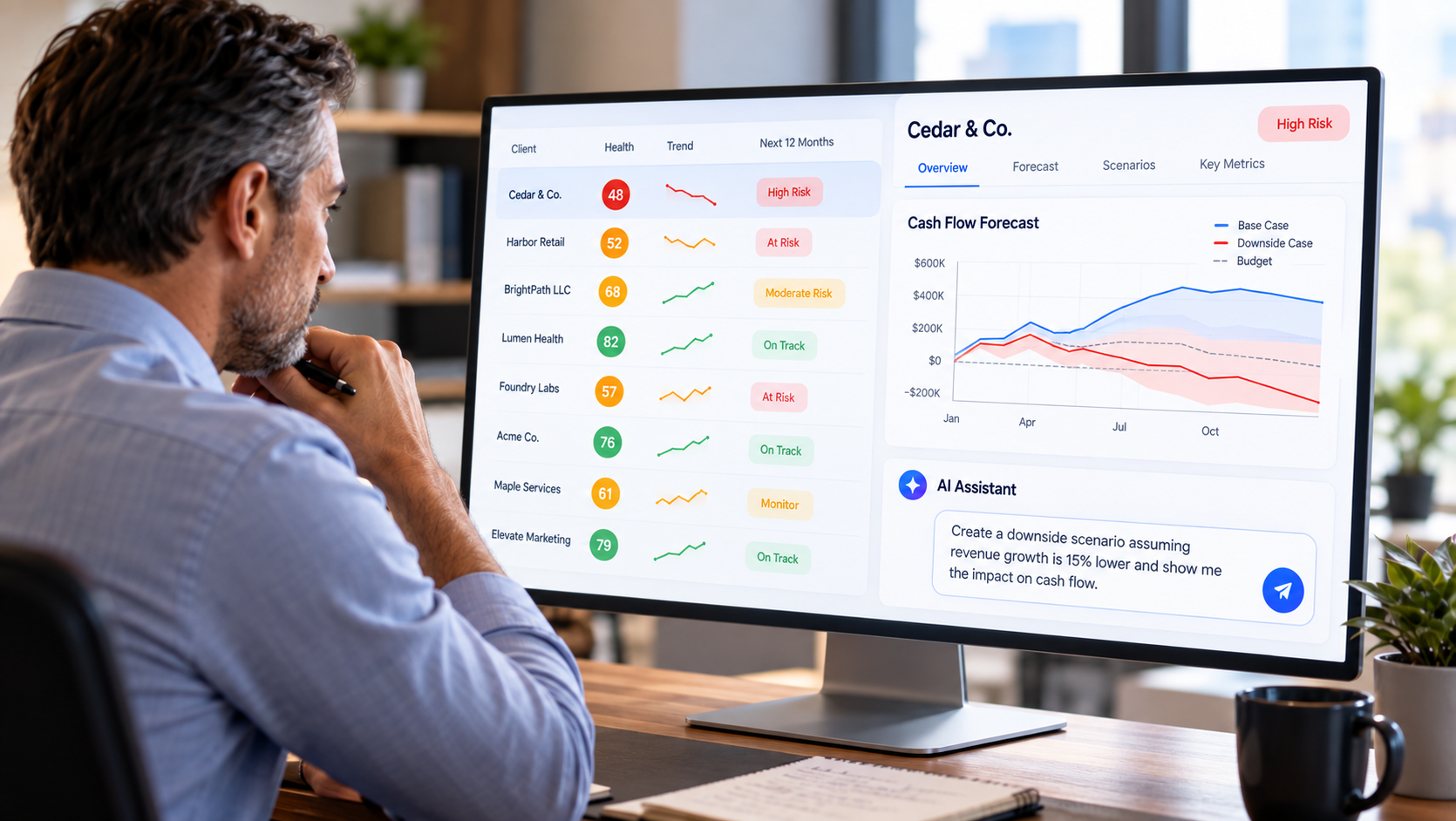
By connecting directly to QuickBooks Online, RunSmart automatically transforms clients' accounting data into forecasts, financial health insights, and client-ready reports in just a few minutes.
RunSmart helps firms not only identify important trends, risks, and opportunities, but also understand what may be driving them and how they could impact the business going forward.
Rather than spending hours gathering information and preparing reports, accounting professionals can focus more of their time on interpreting results, discussing implications, and helping clients make informed decisions.
Moving Beyond Compliance Work
When advisory services are standardized and much of the preparation is automated, something important happens.
Advisory becomes scalable.
And when advisory becomes scalable, it transforms from an occasional value-add into a repeatable service that can:
- Generate additional revenue
- Strengthen client relationships
- Increase client retention
- Differentiate a firm from competitors
- Help firms compete on more than just compliance work
The firms that successfully build advisory practices are not necessarily the ones with the most expertise.
They're often the ones that create repeatable processes that allow them to consistently deliver value across their client base.
By starting with simple observations, standardizing deliverables, and automating preparation, CPAs and bookkeepers can begin offering advisory services in a way that is both practical and scalable.
The goal isn't to transform into a fractional CFO overnight.
The goal is to take the first step, create a repeatable process, and build from there.