For many startup founders, financial planning becomes more important right around the time it also becomes more confusing.
Revenue starts coming in. Expenses begin increasing. Hiring decisions get more serious. Cash becomes harder to manage. And suddenly, the simple spreadsheet that worked in the early days no longer gives you enough visibility into where the business is heading.
At that point, many founders start asking the same question:
Do we need a CFO?
The answer depends on what kind of financial help your business actually needs.
Some companies truly need hands-on CFO support. They may be raising capital, preparing for a board meeting, managing complex financial decisions, or building a more sophisticated finance function. In those cases, an outsourced CFO or fractional CFO can be a valuable partner.
But many startups are not there yet.
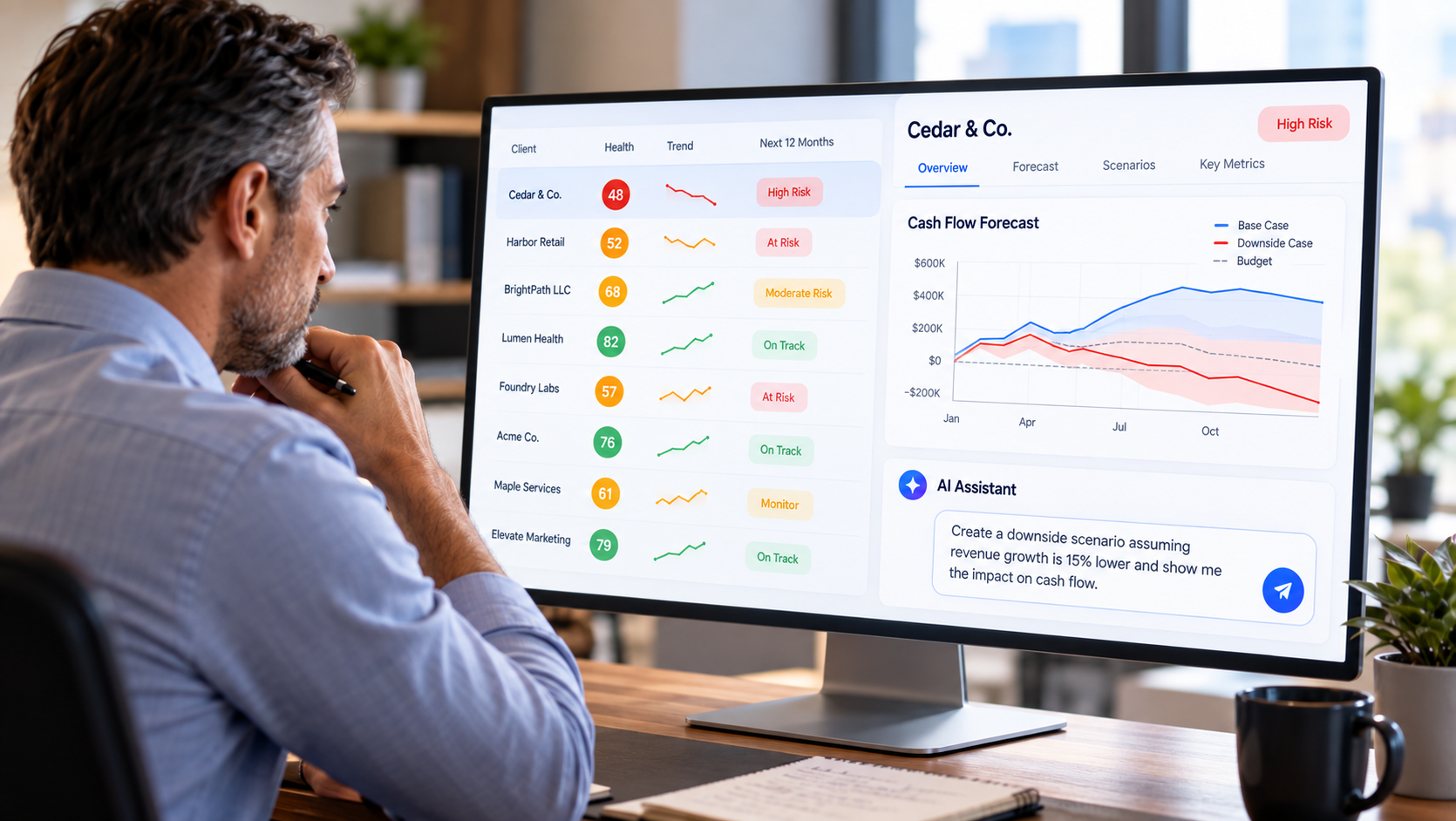
They do not necessarily need a high-touch CFO engagement. They need a better way to forecast revenue, understand cash flow, model hiring decisions, track performance against budget, and identify financial risks before they become bigger problems.
That is where FP&A software can be a better starting point.
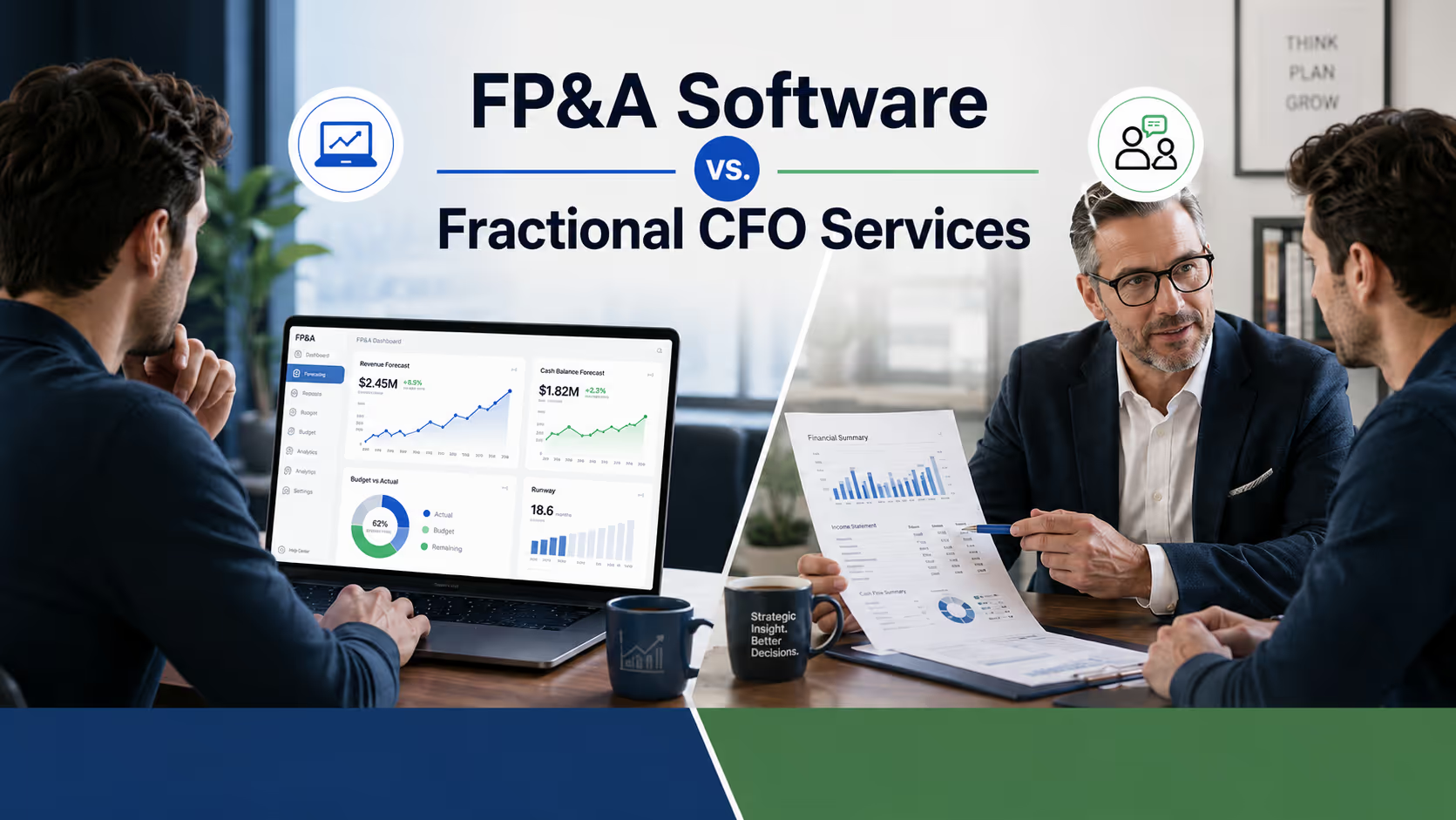
The Difference Between FP&A Software and Fractional CFO Services
FP&A stands for financial planning and analysis. In simple terms, FP&A helps a business understand what has happened, what may happen next, and how different decisions could impact future performance.
Fractional CFO services are different. They usually combine financial analysis with human advisory, strategic guidance, and hands-on support from an experienced finance professional.
Both can be valuable. But they are not the same thing.
The key question is not which option is “better.”
The better question is:
What level of financial support does your startup need right now?
When Fractional CFO Services Make Sense
Outsourced CFO services can be extremely useful when your business needs more than software.
A fractional CFO or outsourced CFO can help with areas such as:
- Fundraising strategy
- Investor reporting
- Board meeting preparation
- Financial storytelling
- Cash management strategy
- Pricing and margin analysis
- Hiring plans
- Budget reviews
- Strategic decision-making
- Finance team structure
- Debt financing or loan preparation
- M&A or exit planning
This type of support can be valuable because it gives founders access to financial expertise without hiring a full-time CFO.
For startups preparing to raise capital, manage rapid growth, navigate cash constraints, or make complex strategic decisions, a human CFO advisor can provide judgment that software alone cannot replace.
That is important to acknowledge.
FP&A software can help organize the numbers, automate parts of the planning process, and highlight potential risks. But it does not replace the experience of a finance leader who can sit with you, challenge assumptions, and help make judgment-based decisions.
When FP&A Software May Be Enough
Many startups do not need full outsourced CFO services yet.
They need visibility.
They need to answer questions like:
- How much runway do we have?
- What happens if we hire two more employees?
- Can we afford to increase marketing spend?
- What if revenue grows slower than expected?
- Are expenses growing faster than revenue?
- Are we on track against budget?
- What does profitability look like over the next 12 months?
- Which areas of the business may create future cash pressure?
- How will today’s decisions impact future financial health?
For these questions, FP&A software may be enough, especially if the founder is not yet ready to pay thousands of dollars per month for ongoing CFO advisory services.
A software-first approach can help founders move beyond static spreadsheets and get a clearer view of the business without immediately committing to a high-touch finance engagement.
Good Bookkeeping Still Matters
FP&A software is not a substitute for accurate bookkeeping.
Forecasts, budgets, financial health indicators, and scenario models are only as reliable as the data behind them. If revenue is misclassified, expenses are posted to the wrong accounts, payroll is inconsistent, or transactions are not reconciled, then any forecast built on that data may be misleading.
In other words, garbage in, garbage out.
This is one reason bookkeeping, accounting, and FP&A should work together. Bookkeeping keeps the historical financial data clean and organized. FP&A software uses that data to help founders understand what may happen next.
For example, if contractor costs are accidentally categorized as software expenses, a founder may misunderstand how much is actually being spent on labor. If revenue is inconsistently categorized, forecasts may show trends that are not real. If loan payments are not properly separated between principal and interest, cash flow and profitability may be distorted.
RunSmart can help turn financial data into forecasts, budget tracking, scenario planning, and financial health insights, but the quality of those insights depends on the quality of the bookkeeping data connected to the platform.
That does not mean your books need to be perfect before you start planning. But they do need to be reasonably accurate, consistently categorized, and up to date.
For many startups, the best setup is:
Accurate bookkeeping + FP&A software + CFO/advisor support when needed.
Bookkeeping explains what happened. FP&A software helps show what may happen next. CFO support can help interpret the numbers and guide more complex decisions.
This is also a good reason not to frame FP&A software as a replacement for bookkeeping or accounting services. A stronger message is:
RunSmart does not replace good bookkeeping. It makes good bookkeeping more valuable by turning clean financial data into forward-looking planning, visibility, and decision support.
Where RunSmart Fits
RunSmart is FP&A software built to help growing startups and small businesses get more visibility from their financial data.
Instead of relying only on spreadsheets or waiting for a monthly financial review, RunSmart helps turn QuickBooks data into forward-looking forecasts, financial health indicators, budget tracking, and scenario planning tools.
RunSmart helps founders understand how decisions may affect future revenue, runway, profitability, and overall financial health.
For example, RunSmart can help model the impact of:
- Hiring plans
- Revenue growth
- Pricing changes
- Spending decisions
- Product launches
- Churn
- Expansion revenue
- Budget changes
- Loan payments
- Cash flow pressure
The goal is not to replace every CFO use case.
The goal is to give founders a more affordable and practical way to understand where the business is heading before they need a full outsourced CFO engagement.
FP&A Software vs. CFO Services: A Practical Decision Framework
Here is a simple way to think about the decision.
You may need FP&A software if:
- You want better visibility into future cash flow
- You need to model hiring or spending decisions
- You want to track actual performance against budget
- You want to understand your financial health each month
- You are still relying on spreadsheets that are hard to maintain
- You do not yet need hands-on strategic finance advice
- You want a lower-cost way to improve planning discipline
- You need forecasts that update as your business changes
- You want to prepare for future CFO-level conversations
You may need outsourced CFO services if:
- You are preparing to raise capital
- You need help creating investor materials
- You have board reporting requirements
- You need expert guidance on complex financial decisions
- You are managing rapid growth or major cash constraints
- You need someone to lead finance strategy
- You need help interpreting the numbers and deciding what to do next
- You are preparing for debt financing, M&A, or a major business transition
- You want regular advisory conversations with an experienced finance leader
You may need both if:
- You want software to handle the repeatable planning work
- You want a CFO advisor to interpret the results
- You need forecasts, budgets, and scenarios to stay updated
- You want better financial data before advisory meetings
- You want to make CFO conversations more efficient and strategic
In many cases, FP&A software and CFO services are not enemies. They can work together.
Software can organize the data, automate the forecast, track performance, and surface risks. A CFO advisor can then use that information to guide bigger decisions.
The Cost Question
Fractional CFO services can be valuable, but they are often expensive because they involve human expertise and recurring advisory time.
For some companies, that cost is justified.
For others, it may be too early.
If a startup mainly needs forecasting, budget tracking, runway visibility, and scenario planning, paying for a full outsourced CFO engagement may be more than the business needs at that stage.
That does not mean CFO services are bad. It means the timing may not be right.
A software-first approach gives founders a way to build financial discipline earlier, at a lower cost, while still leaving room to add CFO support later when the business becomes more complex.
Example: Hiring Decision
Imagine a startup founder wants to hire a new sales rep.
Without FP&A software, the founder may ask:
Do we have enough cash to hire right now?
That question is too limited.
A better set of questions would be:
- What will this hire do to monthly payroll?
- How does the added expense affect runway?
- How much revenue would this person need to generate?
- What happens if ramp time is slower than expected?
- What if revenue growth misses the forecast?
- Can the business still remain financially healthy after the hire?
A Fractional CFO could help analyze this decision.
But FP&A software can also give the founder a faster and more affordable way to model the financial impact before making the decision.
That is the value of RunSmart.
It helps founders see the potential impact of decisions before those decisions become permanent expenses.
Example: Revenue Growth Without Profit Growth
Revenue growth is exciting, but it does not always mean the business is getting healthier.
A company may grow revenue while also increasing payroll, software costs, contractor expenses, marketing spend, and overhead. If expenses grow faster than revenue, the business may still end up with weaker profitability or tighter cash flow.
This is where founders need more than a basic profit and loss statement.
They need to understand:
- Whether margins are improving or declining
- Whether operating expenses are growing too quickly
- Whether revenue growth is translating into profit
- Whether cash flow is improving or getting worse
- Whether the business is becoming more or less financially healthy
RunSmart helps make those patterns easier to see.
Instead of only looking backward at what happened last month, founders can use forward-looking planning to understand where the business may be headed.
The Best Path for Many Startups
For many growing startups, the best path is not immediately choosing between software and CFO services.
The better path is a staged approach.
Stage 1: Founder-led planning
At the earliest stage, the founder may manage finances directly with basic accounting reports and simple spreadsheets.
This can work for a while, but it often becomes harder as revenue, expenses, payroll, and growth plans become more complex.
Stage 2: FP&A software
As the business grows, FP&A software can help create structure.
This is where RunSmart fits.
The founder gets forecasts, budget tracking, financial health indicators, and scenario planning without immediately paying for a full outsourced CFO relationship.
Stage 3: CFO advisory
Later, when the business needs strategic finance guidance, fundraising support, investor reporting, or more complex decision-making, Fractional CFO services may become a strong next step.
At that point, the company is also better prepared because it already has financial planning systems in place.
RunSmart Is Not a Replacement for Every CFO
It is important to be clear: RunSmart does not replace every function of a CFO.
A CFO can bring judgment, experience, strategic guidance, investor communication, financing expertise, and leadership that software cannot fully replicate.
But not every startup needs all of that right away.
Many founders first need a clearer way to understand their numbers.
RunSmart is designed for that stage.
It gives founders a practical way to forecast, plan, track progress, and model decisions before they are ready for full CFO support.
Choose the Right Level of Financial Support for Your Startup
Fractional CFO services can be a smart investment for startups that need hands-on financial leadership, fundraising support, board reporting, or strategic guidance.
But for many startups, the immediate need is simpler:
They need to understand where the business is heading.
They need to know how hiring, spending, pricing, growth, and cash flow decisions may affect the future.
They need a better way to plan before they commit to expensive decisions.
That is where FP&A software like RunSmart can be a strong starting point.
RunSmart helps founders move beyond static spreadsheets and basic accounting reports by turning financial data into forecasts, budget tracking, financial health insights, and what-if planning.
For startups that are not ready to pay for Fractional CFO services, RunSmart can provide a more affordable way to get CFO-style visibility into the business.
And when the time does come to work with a CFO, the business will already have a stronger financial planning foundation in place.