Accounting firms have traditionally managed clients one at a time.
Need to understand how a client is performing? Open their QuickBooks file. Need to identify a cash flow concern? Review their financial statements. Need to prepare for a client meeting? Analyze their numbers individually.
That approach works when a firm has a handful of clients. It becomes much harder when an accountant, bookkeeper, or fractional CFO is responsible for dozens or even hundreds of businesses.
A new generation of accounting technology is beginning to address that problem by looking across the entire client portfolio instead.
Intuit's new Accountant Suite is one prominent example. Its Client Insights and Intuit Intelligence capabilities are designed to help accounting firms identify issues and compare information across multiple QuickBooks clients without reviewing every company individually.
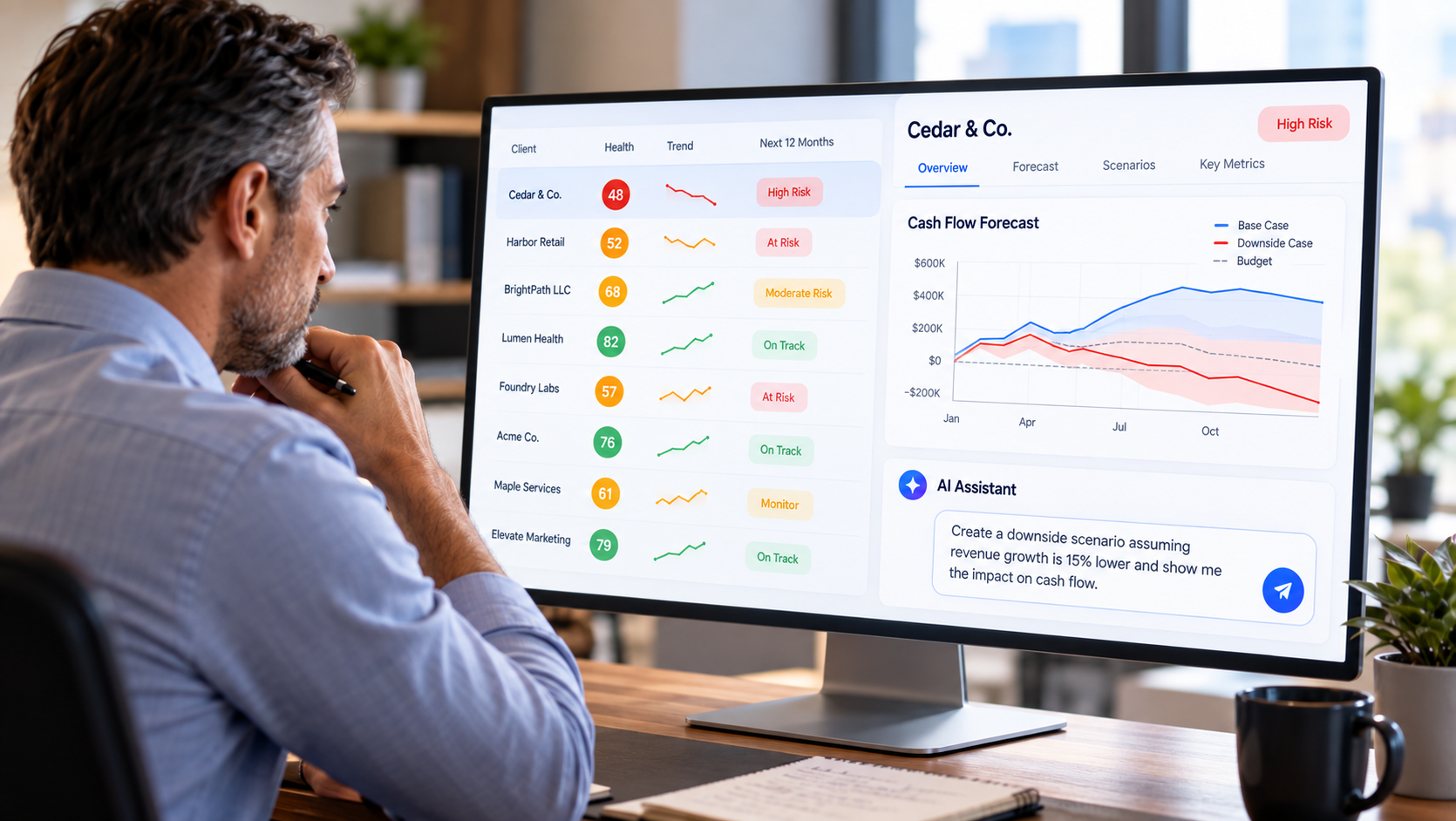
RunSmart by Projection Genie approaches the same fundamental problem from a different direction: helping accounting professionals identify which clients may need financial and advisory attention, including where those businesses may be headed next.
That distinction represents an important evolution from client management to what we call cross-client advisory intelligence.
What Is Cross-Client Advisory Intelligence?
Cross-client advisory intelligence is the ability to analyze financial performance, financial health, forecasts, scenarios, and emerging risks across an accounting firm's client portfolio rather than reviewing every client individually.
Consider an accountant responsible for 50 businesses.
The traditional workflow requires the accountant to know which clients deserve investigation before opening their books.
Portfolio intelligence reverses that process.
Instead of asking:
"Which client should I review?"
the software can help answer:
"Which of my clients need my attention, and why?"
For accounting firms expanding into Client Advisory Services (CAS), that can fundamentally change how advisory work is delivered.
Rather than relying primarily on scheduled reviews or waiting for clients to ask for help, accountants can identify potential issues across their portfolio and initiate conversations proactively.
Intuit Is Bringing Portfolio Intelligence Directly Into QuickBooks
Intuit Accountant Suite represents an important shift toward this model.
Intuit's Cross Client Portfolio Insights automatically reviews an accounting firm's client list and highlights five clients experiencing significant financial changes on the firm's Home dashboard.
The signals currently include issues such as disconnected bank accounts, unposted transactions, and past-due accounts receivable. Accountants can then open the broader Client Insights Hub to review additional clients.
Intuit Accountant Suite Accelerate also provides Client Insights with portfolio-wide KPIs, customizable dashboards, client groups, AI-powered anomaly detection, and cross-client analysis.
The direction is clear:
Accounting firms should not have to open every client file individually to discover what requires their attention.
We agree.
In fact, RunSmart's Portfolio View was designed around the same fundamental idea.
But there is another question we believe accounting firms increasingly need their technology to answer:
What might happen next?
Operational Attention vs. Advisory Attention
This distinction is important.
Imagine an accounting platform tells you:
"Client ABC's bank account has been disconnected."
That's valuable. The accountant knows something requires operational attention.
Now consider a different alert:
"Client XYZ's liquidity has been deteriorating, and its financial forecast indicates increasing cash flow pressure over the next 12 months."
That requires a very different kind of attention.
The first may require fixing something in the books.
The second may require a conversation with the business owner.
We think of this as the difference between operational attention and advisory attention.
Accounting firms need both.
Operational intelligence helps firms determine what work needs to be completed.
Advisory intelligence helps firms determine which clients may need financial guidance, planning, or a conversation about what lies ahead.
RunSmart is designed around the second problem.
How RunSmart's Portfolio View Works
RunSmart automatically transforms QuickBooks Online financial data into financial analysis, forecasts, KPIs, financial health measurements, and other forward-looking insights.
For accounting firms managing multiple RunSmart projects, Portfolio View brings client-level intelligence together so professionals can monitor their book of business without opening every project individually.
Instead of simply functioning as a directory of clients, Portfolio View is designed to help surface emerging financial risks and changes that may deserve attention.
This creates a different workflow.
Instead of:
Client → Financial Statements → Analysis → Discover Problem
the goal becomes:
Portfolio → Identify Potential Problem → Client → Investigate
That difference becomes increasingly valuable as an accounting firm's client count grows.
If you manage five businesses, reviewing them individually may be practical.
If you manage 50, 100, or 200 businesses, it becomes much more difficult to know where to focus your limited advisory time.
Portfolio intelligence helps answer that question.
Intuit Accountant Suite vs. RunSmart: Different Layers of Portfolio Intelligence
Intuit Accountant Suite and RunSmart should not necessarily be viewed as replacements for one another.
RunSmart uses QuickBooks Online as a primary financial data source. The two platforms can therefore serve different roles within the same accounting technology stack.
The difference is less about which platform has a "portfolio view" and more about what kind of intelligence is being brought into that view and what professionals can do with that intelligence.
What Can Intuit Intelligence Ask Across Clients?
Intuit is also introducing the ability to ask AI questions across multiple clients.
This is an important development.
Examples provided by Intuit include questions such as:
"Which of my clients have broken bank connections?"
or identifying clients whose transaction volume has increased significantly.
According to Intuit's current documentation, cross-client questions are in beta and work best with high-level metrics such as bank connections, unposted transactions, and accounts receivable or accounts payable aging. Intuit also notes that the current capability can compare top-level figures but does not drill into transaction-level detail.
Those capabilities can save accounting firms considerable time.
But they also demonstrate where cross-client intelligence could go next.
What if an accountant could ask questions not only about what has happened across the client portfolio, but also about what financial models indicate could happen next?
And what if the accountant could then act on what they discovered by modeling different possibilities directly through the same conversation?
Moving From Cross-Client Search to Cross-Client Financial Intelligence
RunSmart is developing an MCP integration designed to make RunSmart's financial intelligence accessible through compatible AI tools.
MCP stands for Model Context Protocol, but accountants shouldn't need to understand the underlying technology to understand its potential value.
The important part is what they will be able to do with it.
Instead of connecting an AI assistant only to raw accounting information, RunSmart's planned integration is designed to give AI access to the financial intelligence RunSmart has already calculated and allow users to interact with RunSmart's financial planning capabilities conversationally.
That can include information such as:
- Historical financial performance
- KPIs and financial ratios
- Financial Health Scorecard results
- Financial forecasts
- Forecast models
- Scenarios
- Budget performance
- Emerging financial risks
- Portfolio-level financial information
- SaaS subscription metrics where Stripe is connected
This creates the potential for AI to do more than retrieve a number or summarize what happened.
An advisor could move from asking a question, to understanding the answer, to modeling what happens if something changes.
Imagine Asking Your Entire Client Portfolio a Question
Instead of opening 37 QuickBooks files individually, imagine asking:
"Which of my 37 clients are projected to experience the greatest cash flow pressure over the next 12 months?"
Or:
"Which clients have experienced declining operating margins while revenue is still growing?"
Or:
"Which clients have weakening liquidity and are forecasted to continue deteriorating?"
Or:
"Which clients should I review before my advisory meetings this month, and what financial changes should I discuss with each?"
An accountant could go even further:
"Compare the Base and Bear forecasts across my clients and show me which businesses are most sensitive to slower revenue growth."
These are not simply accounting-data retrieval questions.
They are cross-client advisory questions.
But identifying an issue is only part of the advisory process.
From Asking Questions to Modeling What Happens Next
Imagine the AI identifies five clients that are projected to experience increasing cash flow pressure.
The accountant could continue the conversation:
"For those clients, create a downside scenario assuming revenue growth is 15% lower than the current forecast and compare the results."
Or after identifying a staffing concern:
"Create a scenario for ABC Company assuming three additional employees are hired beginning in January and show me the impact on profitability and cash flow."
Or:
"Create a custom sales forecast using these assumptions and compare it with the current Base forecast."
The advisor hasn't started a separate analysis.
It's the continuation of the same question.
Ask → Understand → Model → Compare
That's where conversational financial planning becomes particularly powerful.
Instead of navigating between multiple clients, reports, forecasts, and scenario-building screens, an accounting professional could use natural language to investigate a portfolio-level issue, drill into an individual business, test different assumptions, and compare the resulting financial outcomes.
The workflow becomes:
Portfolio → Identify → Investigate → Model → Compare
That represents something fundamentally different from simply asking an AI assistant to retrieve accounting data.
QuickBooks Data Is the Foundation. Financial Intelligence Is the Next Layer.
QuickBooks contains an enormous amount of valuable financial information.
RunSmart doesn't attempt to replace that foundation.
Instead, RunSmart sits on top of accounting data and automatically turns it into additional financial intelligence.
The process looks something like this:
QuickBooks Data → Financial Analysis → KPIs → Financial Health → Forecasts → Scenarios → Emerging Risks → Portfolio Intelligence
MCP adds a conversational layer across that intelligence:
RunSmart Financial Intelligence ↔ Conversational AI
The relationship works in both directions.
An AI assistant can access RunSmart's financial intelligence to answer questions and perform analysis, while the user can also use the conversation to create or modify financial planning scenarios and explore different assumptions.
This means an accountant doesn't necessarily need to know which report to open, which ratio to calculate, which client to investigate first, or which planning screen to navigate to next.
They can start with a business question and continue from the answer directly into financial modeling.
Stripe Adds Another Dimension for SaaS-Focused Accounting Firms
RunSmart is also expanding beyond accounting data.
Our upcoming Stripe integration will combine SaaS subscription information with QuickBooks financial data.
That means SaaS founders, accountants, and fractional CFOs will be able to evaluate subscription metrics such as MRR, ARR, churn, retention, and customer growth alongside profitability, cash flow, financial health, and forecasts.
For an accounting firm specializing in SaaS businesses, cross-client intelligence could answer questions such as:
"Which of my SaaS clients are growing ARR but becoming less profitable?"
"Which clients have declining retention and increasing forecasted cash flow pressure?"
"Which SaaS clients appear most financially sensitive to slower customer growth?"
"Which clients have strong subscription growth but weakening liquidity?"
And the advisor could continue directly into modeling:
"For the clients with declining retention, create a scenario assuming churn increases another two percentage points and show me how that affects their forecasts."
Instead of analyzing subscription performance in one system, financial performance in another, and then manually rebuilding assumptions in a financial model, the objective is to connect those perspectives through conversational financial planning.
Why This Matters for Client Advisory Services
CAS is often discussed in terms of dashboards, reports, forecasting, and monthly client meetings.
But there is another challenge that becomes more important as an advisory practice grows:
How does the advisor know where to spend their time?
Every client does not require the same amount of attention every month.
Some may be performing exactly as expected.
Others may be experiencing changes that haven't yet become obvious.
The ability to monitor financial health and forward-looking indicators across an entire client portfolio can help an advisor identify those situations earlier.
That can make advisory more proactive.
Instead of waiting for the business owner to recognize a problem and call their accountant, the accountant can potentially initiate the conversation:
"I noticed something changing in your numbers that I think we should discuss."
And rather than arriving at that conversation with only an observation, the advisor could have already modeled several possible outcomes.
That's a very different client experience.
Portfolio Intelligence Is Becoming a New Layer of the Accounting Technology Stack
Intuit's investment in Client Insights, anomaly detection, and cross-client AI reinforces a broader trend in accounting technology.
The client file is no longer the only useful unit of analysis.
The client portfolio itself is becoming a source of intelligence.
For accounting firms, this means technology can increasingly help answer four different questions:
What needs to be done?
Operational systems can identify bookkeeping tasks, disconnected accounts, outstanding transactions, and workflow issues.
What is happening?
Financial analysis can identify changes in revenue, margins, liquidity, KPIs, and overall financial performance.
What might happen next?
Forecasting and forward-looking financial analysis can help firms understand where clients may be headed.
What if something changes?
Scenario modeling can help advisors explore how changes in revenue, expenses, staffing, subscription performance, or other assumptions could affect future financial performance.
RunSmart is focused heavily on the latter questions while connecting them to what has already happened.
The Future Isn't Another Dashboard
Dashboards are useful.
But an accounting professional managing dozens of clients doesn't necessarily need another place containing hundreds of numbers.
They need help deciding which numbers matter right now and which clients deserve attention.
Portfolio intelligence moves accounting technology closer to that goal.
AI can take it another step by allowing professionals to interrogate that intelligence conversationally and then act on what they discover through financial modeling.
And combining historical accounting information with financial forecasts, scenarios, financial health indicators, subscription data, and other operational information can take it further still.
The ultimate objective isn't to replace the accountant's judgment.
It's to make it easier for an accountant to apply that judgment across a much larger client base.
Instead of asking:
"Which client should I open next?"
the accounting platform of the future should increasingly be able to help answer:
"Which clients need my attention, what changed, what might happen next, and what happens if we change the assumptions?"
That's the future of cross-client advisory intelligence we're building toward with RunSmart.