

AI is rapidly changing how people interact with software.
Instead of navigating through menus, configuring reports, exporting data, and manually piecing together answers, users are increasingly going to expect to simply ask a question and have an AI agent do the work for them.
Want to know which customers are most at risk? Ask.
Want to understand why expenses increased last quarter? Ask.
Want to know what happens to cash flow if you hire five employees next year? Ask.
This shift has led some to predict that AI agents will eventually replace many of the software applications businesses use today.
We believe the reality is more nuanced.
AI may dramatically change the interface through which people interact with software, but underneath that interface businesses will still need reliable systems capable of storing data, performing calculations, enforcing rules, running models, and producing consistent results.
This is particularly important when dealing with financial data.
The future of financial software may therefore be less about replacing deterministic software with AI and more about giving AI access to deterministic financial systems it can reliably use.
Put more simply:
The AI shouldn't be the financial model. The AI should know how to use the financial model.
AI Is Changing the Interface to Business Software
Traditional business software was designed primarily around a graphical user interface.
A user logs into an application, navigates to a particular section, selects some options, runs a report, reviews the results, and decides what to do next.
AI agents have the potential to dramatically simplify that process.
Instead of learning where information lives within an application, users may increasingly interact with software by expressing what they are trying to accomplish.
A business owner might ask:
"Can we afford to hire three additional employees next quarter without creating a cash flow problem?"
A SaaS founder might ask:
"What happens to our runway if customer churn increases from 2% to 3% and we hire two engineers in January?"
An accountant might ask:
"Which of my clients appear to have the greatest financial risk over the next 12 months?"
These questions are much closer to how people naturally think about their businesses than navigating through a series of screens.
But understanding the question is only part of the problem.
Something still has to calculate the answer.
AI Is Not a Substitute for a Financial Engine
Large language models are extremely good at understanding language, interpreting intent, synthesizing information, and explaining complicated concepts.
Those capabilities make them an incredibly powerful interface for financial software.
But financial analysis frequently requires something different: consistent, reproducible calculations based on defined data and rules.
Consider a seemingly simple question:
"What will my cash balance look like 12 months from now?"
Answering that question reliably could require forecasting dozens or hundreds of revenue and expense accounts, projecting accounts receivable and payable, incorporating payroll changes, accounting for debt payments, modeling capital expenditures, and connecting the resulting income statement, balance sheet, and cash flow statement.
Now consider:
"What happens if we increase hiring by 20%?"
The system may need to model compensation, payroll taxes, benefits, hiring dates, expense classifications, revenue assumptions, cash requirements, profitability, and potentially financing requirements across multiple future periods.
An AI model could attempt to reason through those calculations itself.
We believe there is a better approach.
Let AI determine what the user is asking.
Let purpose-built financial software determine what the numbers say.
Deterministic Financial Intelligence Becomes More Important in an AI World
This distinction is central to how we think about the future of financial software at Projection Genie.
RunSmart was designed around deterministic financial analysis.
Historical financial data is analyzed using defined calculations and forecasting methodologies. Financial ratios are calculated consistently. Forecasts are generated by purpose-built forecasting engines. Scenarios flow through structured financial models. Financial statements remain mathematically connected.
Given the same data, assumptions, and configuration, the underlying financial engine should produce the same result.
AI can then sit above that infrastructure.
Instead of asking an AI model to invent a forecast, an agent could request the forecast calculated by RunSmart.
Instead of asking AI to estimate the financial consequences of hiring employees, it could retrieve the results of a scenario modeled within RunSmart.
Instead of asking AI to independently determine whether liquidity is deteriorating, it could retrieve financial health indicators already calculated from the company's financial data.
This creates a separation between two very different responsibilities:
AI handles intent, interaction, orchestration, and explanation.
RunSmart handles financial data, calculations, forecasting, scenario modeling, and financial intelligence.
We believe combining those capabilities is significantly more powerful than asking either one to do everything.
From Systems of Record to Financial Intelligence
Most businesses already have systems containing enormous amounts of useful operational data.
QuickBooks contains accounting and financial history.
Stripe contains detailed subscription and billing activity for SaaS businesses.
HR systems contain information about employees, compensation, roles, and workforce changes.
Each is valuable on its own.
But answering forward-looking business questions often requires bringing information from multiple systems together and transforming it into something those underlying systems were not designed to provide.
That's the role we see RunSmart playing.
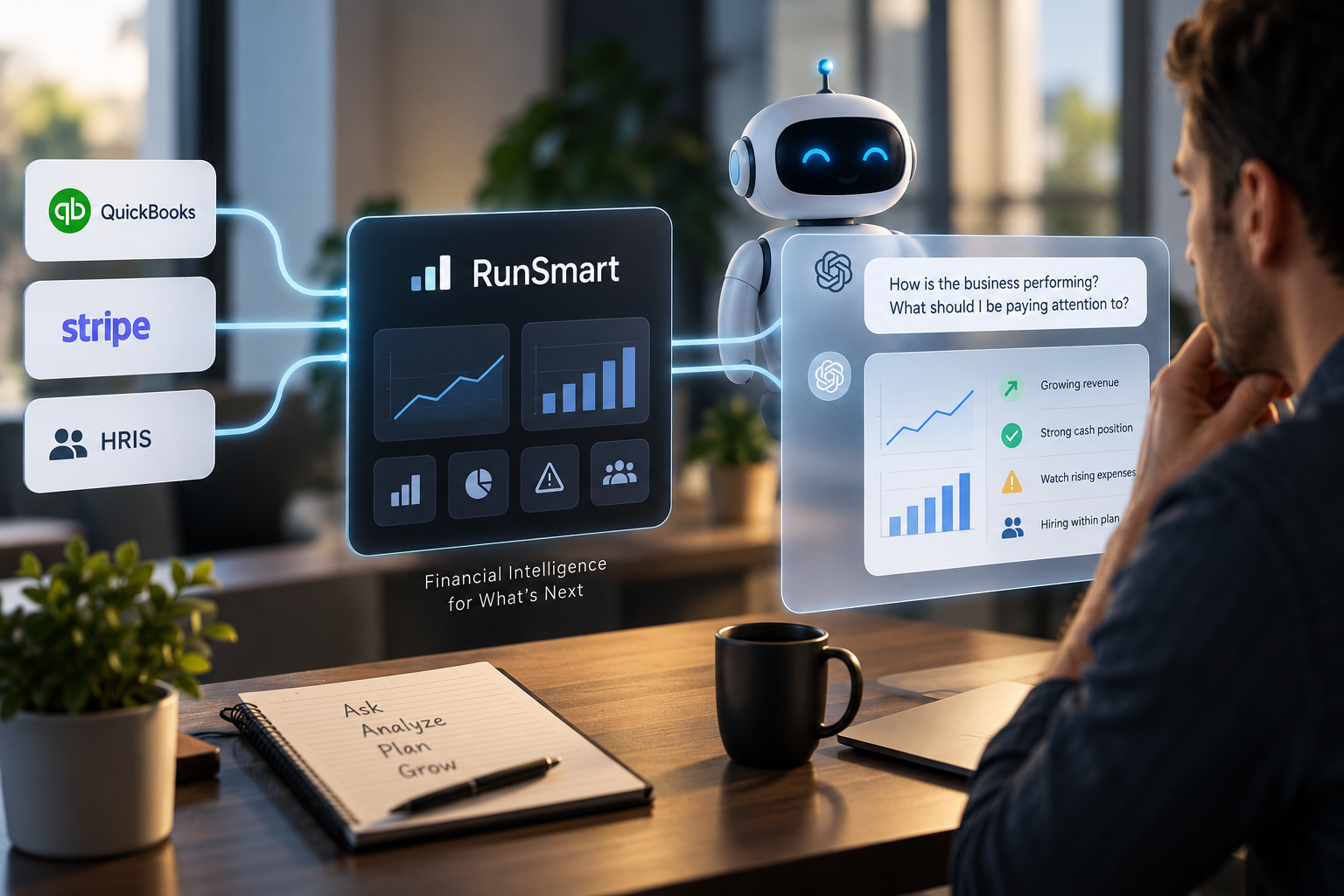
Rather than becoming another system of record, RunSmart can act as a financial intelligence layer above the systems of record businesses already use.
The architecture looks something like this:
Systems of Record
QuickBooks + Stripe + HRIS
↓
Financial Intelligence
RunSmart
Forecasting • Financial Health • KPIs • Scenario Modeling • Workforce Planning • Budgeting • Risk Detection
↓
AI and Agents
Natural-language questions • Analysis • Orchestration • Explanations
The underlying systems provide the data.
RunSmart provides the financial intelligence.
AI provides a dramatically easier way to access and interact with it.
Consider the Difference in Practice
Imagine a SaaS founder asking an AI assistant:
"How is the business performing, what risks should I be paying attention to, and what does our current forecast look like over the next 12 months?"
An AI assistant connected directly to accounting and subscription data would have access to a tremendous amount of raw information, but it would still need to determine how that information should be analyzed.
An AI assistant connected to RunSmart could operate differently.
RunSmart could provide the forecasts already generated by its forecasting engine, financial health indicators, SaaS and core KPIs, cash flow outlook, risk signals, and other structured financial intelligence.
The AI's job becomes understanding the question, retrieving the appropriate intelligence, connecting relevant information, and explaining it.
The underlying financial analysis remains deterministic.
Making RunSmart Usable by AI Through MCP
This is where Model Context Protocol, or MCP, fits into our longer-term vision for RunSmart.
Rather than simply adding a chatbot to RunSmart, our approach is to make RunSmart's underlying financial intelligence available to AI applications and agents through a structured MCP layer.
We don't want an AI model to receive a large collection of raw accounting transactions and attempt to recreate RunSmart's financial analysis itself because there are several problems with that approach.
Financial analysis often involves hundreds or thousands of interconnected calculations, defined accounting relationships, historical comparisons, forecasting methodologies, and assumptions that need to be applied consistently. Asking a generative AI model to reconstruct that logic each time a user asks a question introduces unnecessary uncertainty into a process where consistency and accuracy are critical.
The same question could potentially be interpreted or calculated differently depending on how it is asked, what information the AI considers relevant, or how the model reasons through the problem. The AI could also misunderstand accounting relationships, omit important inputs, apply an inappropriate calculation, or generate a result that appears financially reasonable but isn't actually supported by the underlying data.
The risk becomes even greater with forward-looking questions.
Generating a reliable forecast isn't simply a matter of asking AI to extrapolate historical revenue or expenses. Different financial accounts can behave very differently over time. Some may be seasonal, some may follow a trend, some may be relatively stable, and others may be difficult to forecast at all. Forecasting those accounts requires evaluating their historical behavior and applying appropriate forecasting methodologies consistently.
Scenario modeling adds another layer of complexity because a change to one assumption can affect multiple parts of the financial model. Hiring an employee, changing pricing, increasing spending, taking on debt, or changing subscriber growth can ultimately affect revenue, expenses, profitability, cash flow, and the balance sheet across multiple future periods.
An AI model shouldn't have to reconstruct those relationships from scratch every time someone asks a question.
It also creates an auditability problem. If a user receives an important financial number, they should be able to understand where it came from and reproduce it. A deterministic financial engine can apply defined calculations and methodologies to defined inputs and return the same result when those inputs remain unchanged. That creates a much clearer source of truth.
This doesn't mean AI can't reason about financial information. It means we believe AI is most valuable when it reasons with reliable financial intelligence rather than attempting to recreate the financial system producing that intelligence.
Our approach is therefore different.
We want AI to be able to call specific RunSmart capabilities and retrieve structured results from calculations performed by the platform.
For example, an AI could ask RunSmart for a company's current financial health, retrieve its forecast, examine individual KPIs, identify existing risk signals, compare financial scenarios, or prepare information needed for an upcoming financial review.
If a user asks why cash flow is expected to decline six months from now, the AI can retrieve the relevant RunSmart forecasts and financial information and help explain what is driving the change. It doesn't need to independently rebuild the company's forecast from thousands of accounting transactions.
That gives each technology the job it is best suited to perform.
RunSmart provides the calculations, financial models, forecasts, and structured financial intelligence.
AI understands what the user is trying to accomplish, determines which RunSmart capabilities it needs, connects the relevant information, and explains the results.
AI applications would be able to retrieve and analyze information from RunSmart without changing the underlying financial model, assumptions, forecasts, or scenarios.
That creates a clear separation between the AI interface and the financial source of truth.
An AI Agent Could Conduct an Entire Financial Review
Consider a business owner preparing for a monthly financial review.
Instead of navigating through numerous dashboards and reports, the owner could ask:
"Give me a financial review of the business and tell me what changed since last month."
An AI agent could use RunSmart to retrieve the relevant financial information.
It could examine recent financial performance, compare actual results with budgets, review changes in key performance indicators, identify emerging financial risks, examine the latest forecast, and surface material changes in cash flow or profitability.
RunSmart would provide the underlying numbers and calculated intelligence.
The AI would organize and explain them.
The same concept could support meeting preparation.
A business owner could ask:
"Prepare me for my meeting with my accountant tomorrow."
Or an advisor could ask:
"Summarize the most important financial developments I should discuss with this client."
Instead of manually assembling information from multiple sections of the application, an AI agent could retrieve the appropriate RunSmart intelligence and construct the financial context needed for the conversation.
Portfolio Intelligence Makes This Even More Powerful
The architecture becomes particularly interesting for accountants, bookkeepers, fractional CFOs, and other advisors responsible for multiple businesses.
Imagine an accountant with dozens of clients asking:
"Which of my 37 clients should I be most concerned about over the next 12 months, and why?"
That's a very different problem from asking AI to summarize a QuickBooks file.
RunSmart can already analyze each company's financial performance, health indicators, forecasts, liquidity, profitability, debt, cash flow, and emerging risks.
Through an AI interface, that intelligence can be examined across an entire portfolio.
An agent could identify clients showing the greatest financial risk, retrieve the underlying indicators contributing to that risk, and help the advisor determine which clients deserve attention first.
The AI isn't independently deciding that a business is financially unhealthy.
It is querying deterministic financial intelligence calculated by RunSmart and helping the advisor understand it.
That distinction is important.
AI Can Also Make Scenario Analysis Easier
Scenario modeling provides another example of how the traditional software interface and an AI interface can complement one another.
RunSmart allows businesses to maintain a Main Analysis Scenario along with additional Bull, Base, Bear, or Custom forecast models.
Through MCP, an AI could retrieve and compare those existing scenarios.
A founder might ask:
"Compare my Base and Bear forecast models and show me where the biggest differences appear over the next 24 months."
The AI wouldn't recreate either financial model.
It would retrieve the scenarios calculated within RunSmart, compare the resulting revenue, expenses, cash flow, profitability, and other metrics, and explain the differences.
Over time, we also see the possibility of allowing AI agents to help users create or modify scenarios.
That requires a higher level of control.
Any future write capabilities would need appropriate permissions and safeguards, and we believe the system-generated Main Analysis Scenario should remain protected from AI modification.
The principle remains the same:
AI expresses and orchestrates the user's intent. RunSmart performs the financial modeling.
The Traditional RunSmart Interface Still Matters
None of this means dashboards, charts, reports, planners, and other application interfaces disappear.
There are many situations where seeing financial information visually is better than discussing it conversationally.
Users may want to inspect a chart, customize a scenario, review a financial statement, build a report, adjust workforce assumptions, or examine the details behind a calculation.
The RunSmart application remains valuable for those activities.
MCP simply creates another way to interact with the same underlying financial intelligence.
A user might begin with a question in an AI assistant, discover something worth investigating, and then open RunSmart to explore the underlying numbers in greater detail.
Or they may perform their analysis in RunSmart and later ask an AI agent to summarize the results.
The graphical application and the AI interface don't need to compete.
They can become two interfaces into the same deterministic financial intelligence platform.
AI Agents Don't Eliminate APIs, Models, or Business Logic
There's a tendency to think about AI agents as eventually replacing software.
We think they are more likely to change the way software is consumed.
APIs still matter.
Databases still matter.
Permissions still matter.
Accounting rules still matter.
Forecasting methodologies still matter.
Financial models still matter.
Auditability still matters.
What changes is that humans may no longer need to directly interact with every part of that infrastructure.
An agent can increasingly do that for them.
That creates a different challenge for software companies.
It may no longer be enough to build a powerful application and expect users to navigate its interface.
Software also needs to become accessible to the AI systems users increasingly rely upon.
The application UI doesn't necessarily disappear. It becomes one interface into the underlying intelligence rather than the only interface.
What We're Building Toward With RunSmart
Our approach can ultimately be summarized as a relatively simple architecture:
QuickBooks, Stripe, and HR systems provide operational data.
RunSmart transforms that data into deterministic, forward-looking financial intelligence.
MCP makes RunSmart's financial capabilities accessible to AI applications and agents.
AI helps users interact with that intelligence through natural language.
That creates a very different experience from simply connecting an AI model to financial data.
The AI doesn't have to become the forecasting engine, financial model, KPI calculator, scenario engine, or financial health system.
RunSmart already performs those jobs.
The AI needs to understand what the user wants, invoke the appropriate RunSmart capabilities, retrieve the results, and communicate them effectively.
The Financial Model Should Remain the Source of Truth
AI will undoubtedly become a larger part of financial software.
But as that happens, we believe maintaining a clear boundary between probabilistic AI and deterministic financial calculations will become increasingly important.
AI is exceptionally good at understanding:
What are you trying to figure out?
Financial software needs to be exceptionally good at determining:
What do the numbers actually say?
That's the philosophy behind the direction we're taking RunSmart.
We're not trying to replace deterministic financial analysis with AI.
We're building deterministic financial intelligence that humans can use directly today and that AI agents can increasingly use on their behalf tomorrow.
The AI shouldn't be the financial model. It should have access to a financial model it can trust.

