

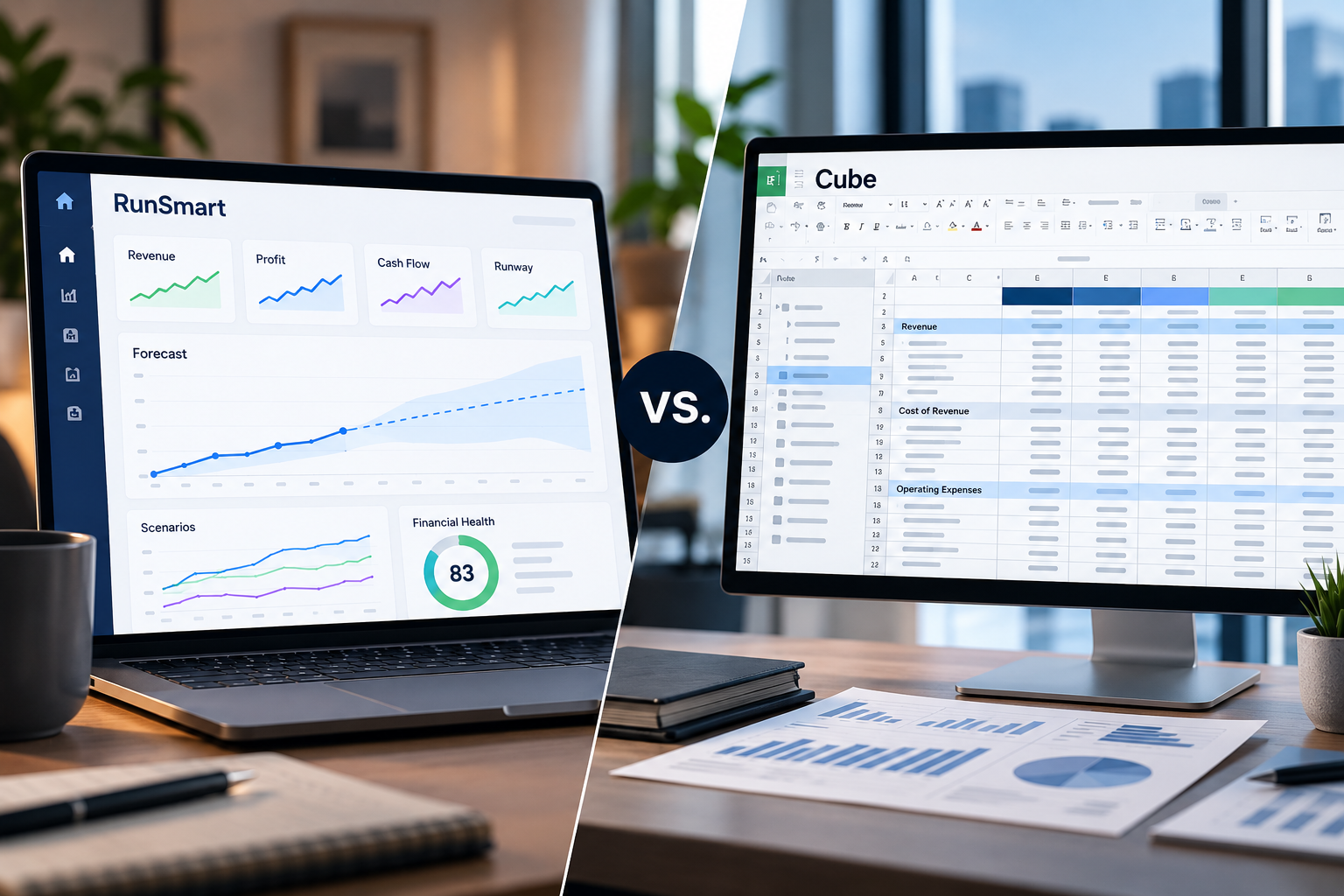
RunSmart by Projection Genie and Cube both help businesses move beyond static accounting reports into financial forecasting, budgeting, scenario planning, reporting, and forward-looking analysis.
But they are designed around very different financial workflows.
Cube is a spreadsheet-native FP&A platform built primarily for finance teams that want to keep working in Excel and Google Sheets while adding governed financial data, multidimensional planning, workflow automation, reporting, AI agents, and centralized financial models underneath those spreadsheets.
RunSmart takes a different approach.
Instead of making spreadsheets more powerful, RunSmart is designed to reduce the need to manually build and maintain financial models in the first place.
RunSmart automatically analyzes historical financial behavior, evaluates statistical forecasting methods, establishes a financial baseline, monitors financial health and emerging risks, and allows users to model how future decisions could affect revenue, profitability, cash flow, and runway.
For SaaS companies using Stripe and QuickBooks Online, RunSmart also connects subscription intelligence across:
Historical → Live / MTD → Forecast
The central distinction is therefore:
Cube is designed to make FP&A teams more powerful.
RunSmart is designed to make much of the financial intelligence normally associated with FP&A accessible without requiring the founder to build an FP&A function first.
This comparison examines RunSmart and Cube across:
- Financial forecasting
- Spreadsheet workflows
- SaaS analytics
- Scenario planning
- Workforce planning
- Budgeting
- Reporting
- AI
- MCP
- Financial health
- Portfolio intelligence
- Multi-entity planning
- Pricing
Note: RunSmart's MCP integration is coming soon and is not yet generally available. References to MCP capabilities in this article describe planned functionality that will be available in a future release.
RunSmart vs. Cube at a Glance
Both platforms can support sophisticated financial planning.
The difference is primarily how users interact with the financial model.
Cube gives finance teams a governed FP&A data and planning layer while allowing them to continue working in familiar tools such as Excel and Google Sheets.
RunSmart performs more of the initial forecasting, financial-health analysis, risk monitoring, and financial interpretation automatically before the user begins changing assumptions.
What Is RunSmart by Projection Genie?
RunSmart is a financial intelligence, forecasting, and planning platform designed for founders, SMBs, accounting firms, advisors, and investors.
RunSmart connects to QuickBooks Online and automatically analyzes historical company financial data.
Its capabilities include:
- Historical financial analysis
- Automated statistical forecasting
- Projected financial statements
- Scenario modeling
- Budgeting
- Budget-versus-actual tracking
- Workforce planning
- Financial-health analysis
- Emerging-risk detection
- Automated financial reporting
- Portfolio-level intelligence
- Collaboration and role-based access
For SaaS companies, RunSmart can also connect Stripe subscription activity with QuickBooks Online financial information.
That adds subscription intelligence including:
- MRR
- ARR
- Active Customers
- Customer Growth
- Customer Churn
- New MRR
- Reactivation MRR
- Expansion MRR
- Contraction MRR
- Churned MRR
- Net New MRR
- NRR
- GRR
- SaaS Quick Ratio
- ARPA
- LTV
- Burn Multiple
- Rule of 40
RunSmart organizes that subscription intelligence into three perspectives:
Historical: What happened during completed periods?
Live / MTD: What is happening with subscriptions during the current month?
Forecast: What may happen next?
This provides a connected view from historical subscription activity through the broader future financial impact.
Does RunSmart Require 24 Months of Financial History?
Not to use the platform.
Businesses can use applicable non-forecasting capabilities before reaching 24 months of financial history.
Depending on the plan, this can include:
- Historical QuickBooks analysis
- Historical Stripe subscription analytics
- Live Subscription Performance
- SaaS KPIs
- Financial-health analysis
- Budgeting
- Workforce planning
- Reporting
At least 24 months of historical financial data is required for RunSmart's automated forecasting capabilities.
Once sufficient history exists, RunSmart can evaluate past behavior and automatically establish a forward-looking baseline.
How Does RunSmart Forecast Financial Performance?
RunSmart does not apply one forecasting method to every financial account.
Instead, it can evaluate multiple statistical forecasting approaches, including:
- Holt-Winters
- Holt linear trend
- Simple exponential smoothing
- ARIMA
- Theta
- Drift
- Mean
- Naive
- Seasonal Naive
- Croston
- Trend and seasonal regression approaches
This matters because financial accounts behave differently.
Revenue may contain:
- Growth
- Seasonality
- Volatility
- Changing trends
Payroll may follow a more stable progression.
Rent may remain relatively flat.
Marketing expenses may fluctuate.
Some accounts may contain intermittent activity.
Rather than asking the user to determine which forecasting methodology belongs on each financial series, RunSmart evaluates historical predictive performance and determines which supported approach is most appropriate.
The user begins with an automatically established financial baseline.
From there, assumptions can be changed involving areas such as:
- Revenue
- Pricing
- Subscriber growth
- Churn
- Expansion
- Contraction
- Hiring
- Compensation
- Marketing
- Operating expenses
- Financing
Those changes can flow through future:
- Revenue
- Expenses
- Profitability
- Cash flow
- Cash balances
- Financial statements
- Financial health
- Runway
What Is Cube?
Cube is a spreadsheet-native FP&A platform designed primarily for finance teams.
Its core philosophy is different from platforms that attempt to replace spreadsheets.
Cube allows finance teams to continue using:
- Microsoft Excel
- Google Sheets
while connecting those spreadsheets to a centralized financial data and planning layer.
Cube can also extend financial workflows into:
- Web-based dashboards
- Slack
- Microsoft Teams
- PowerPoint
- Google Slides
- AI assistants
This means finance teams can continue using familiar spreadsheet models while Cube handles areas such as:
- Centralized financial data
- Version control
- Access permissions
- Dimensional planning
- Data integrations
- Budgeting
- Forecasting
- Reporting
- Consolidation
- Workflows
- AI-assisted FP&A
Cube currently positions itself as an Agentic Finance Layer for teams that live in spreadsheets.
Does Cube Replace Excel or Google Sheets?
No.
That is one of Cube's primary differentiators.
Cube is intentionally designed to work with Excel and Google Sheets rather than force finance teams to abandon them.
Finance users can continue building and working with familiar spreadsheet models while Cube synchronizes governed financial information underneath them.
This is particularly valuable for FP&A professionals who already have:
- Complex financial models
- Existing spreadsheet templates
- Management reporting packages
- Board reporting models
- Department planning workbooks
and do not want to rebuild those processes inside an entirely different modeling interface.
Cube describes its spreadsheet connections as bi-directional, meaning finance teams can pull governed data into spreadsheets and write planning data back into Cube.
What Is the Biggest Difference Between RunSmart and Cube?
The biggest difference is whether the user is expected to maintain the financial model.
Cube assumes that spreadsheets remain an important part of the FP&A workflow.
It makes those spreadsheets significantly more scalable by adding:
- Governed data
- Centralized assumptions
- Dimensions
- Permissions
- Workflow automation
- Integrations
- AI
- Version control
- Financial consolidation
RunSmart starts from a different premise.
It is designed for users who may not want to build or maintain a complex financial model at all.
Once sufficient history exists, RunSmart automatically:
- Analyzes historical financial behavior
- Evaluates statistical forecasting approaches
- Determines appropriate models
- Establishes a baseline forecast
- Calculates future financial statements
- Evaluates financial health
- Monitors emerging risks
The user can then focus on changing assumptions and evaluating decisions.
A simplified distinction is:
Cube: Keep the spreadsheet model, but make the data, governance, automation, collaboration, and AI around it much more powerful.
RunSmart: Automate more of the model-building and financial-analysis process so the user does not have to maintain that spreadsheet infrastructure.
Which Platform Is Better for Financial Forecasting?
Both provide substantial forecasting capabilities, but their approaches are different.
RunSmart
RunSmart emphasizes automated statistical baseline forecasting.
The platform evaluates different forecasting methods based on historical financial behavior and creates a starting outlook automatically.
Users then modify assumptions or build scenarios around that baseline.
Cube
Cube is more closely aligned with traditional FP&A modeling.
Finance teams can use existing spreadsheet models or construct planning models around drivers such as:
- Revenue growth
- Customer volume
- Pipeline
- Headcount
- Pricing
- Units
- Department spending
- Operational metrics
Cube also provides AI-assisted forecasting and modeling through its FP&Agents.
The difference is therefore not whether Cube can forecast.
It clearly can.
The distinction is:
RunSmart automates more of the methodology used to establish the starting forecast.
Cube gives finance teams greater control over constructing and maintaining the underlying planning model.
How Does Cube Use AI?
AI has become a major part of Cube's platform.
Cube calls its purpose-built AI system FP&Agents.
These are organized into four specialist teams:
Planner Agents
Focused on areas such as:
- Forecasting
- Scenario planning
- Financial modeling
- Formula development
- Reforecasting
Analyst Agents
Focused on:
- Variance analysis
- Drilldowns
- Root-cause analysis
- Financial insights
- Anomaly detection
Business Partner Agents
Focused on areas such as:
- Financial reports
- Boards
- Presentations
- Management communication
Data Manager Agents
Focused on:
- Data preparation
- Mapping
- Validation
- Financial-data quality
Cube also provides an AI assistant called Charlie.
Charlie acts as the front door to the different FP&Agent teams.
Instead of requiring the finance user to determine which agent should handle a request, Charlie can interpret the question, coordinate the relevant tasks, and return an answer using Cube's governed financial data.
What Can Charlie Do in Cube?
Cube's Charlie assistant can answer questions using the financial information already stored and governed inside Cube.
Examples could include:
- Why is G&A over budget?
- What is driving the revenue variance?
- How has runway changed?
- Which departments are exceeding plan?
- What happens under a downside scenario?
Charlie is available across multiple Cube surfaces, including the Cube Workspace and supported spreadsheet and communication environments.
Cube emphasizes that these AI interactions use the same underlying financial permissions and governed data available to the user.
This is important for finance teams because AI responses can remain tied to the financial model instead of operating on disconnected spreadsheet uploads.
How Does RunSmart Use AI Differently?
RunSmart separates the underlying financial calculations from the AI interaction layer.
Its:
- Forecasts
- Financial statements
- SaaS metrics
- Health scores
- Risk signals
- Scenario results
- Portfolio metrics
are calculated by RunSmart's deterministic and statistical financial engine.
Generative AI is not responsible for determining the underlying financial forecast.
RunSmart's MCP architecture is designed to allow compatible AI assistants to work with the financial intelligence already calculated inside the platform.
That means an AI assistant could potentially help users:
- Retrieve financial information
- Explain results
- Compare scenarios
- Review SaaS metrics
- Investigate financial health
- Review emerging risks
- Analyze portfolio information
- Prepare for meetings
The architectural distinction is:
RunSmart calculates the financial intelligence first.
AI then helps the user interact with it.
Cube integrates AI more deeply into the FP&A workflow itself, including model building, scenarios, reporting, data management, and financial-analysis tasks.
Cube vs. RunSmart for MCP
Both platforms use Model Context Protocol to make financial information accessible through compatible AI assistants.
But Cube currently provides a substantially broader MCP action layer.
Cube MCP
Cube's MCP Server can connect governed financial data with AI systems such as:
- ChatGPT
- Claude
- Microsoft Copilot
- Other compatible AI environments
With read access, AI tools can query areas such as:
- Actuals
- Budgets
- Forecasts
- Variances
- Planning tables
- Workflows
- Source information
Cube can also grant explicit MCP write permissions.
With appropriate authorization, AI tools can perform actions such as:
- Create scenarios
- Write updated figures into approved scenarios
- Populate planning tables
- Build and update Boards
- Create formulas
- Create tags
- Draft workflows
- Create workflow tasks
- Refresh actuals from configured source connections
Cube places controls around that write-back.
For example, AI cannot simply overwrite any scenario it chooses.
Existing scenarios must explicitly be opened for AI write-back, and actions remain subject to the user's permissions and data-access scope.
RunSmart MCP
RunSmart's MCP is designed more around accessing and working with calculated financial intelligence.
That can include:
- Historical financial performance
- Forecasts
- Scenario results
- SaaS metrics
- Financial health
- Emerging risks
- Portfolio intelligence
For example, a user could ask an AI assistant:
Which clients have the weakest forecast liquidity?
Compare the Base and Bear forecasts for this business.
Which SaaS companies have declining NRR?
Summarize the most important financial risks across this portfolio.
Cube therefore currently has the advantage in MCP depth, especially for authorized write-back and financial-model actions.
RunSmart's differentiation is that the financial intelligence exposed through MCP is already calculated by its forecasting, health, risk, SaaS, and portfolio engines.
Which Platform Is Better for SaaS Companies?
Both can support SaaS companies, but the SaaS workflows are very different.
Cube can ingest financial and operational information from multiple systems and allow finance teams to build SaaS planning models around that information.
A finance team could construct models involving:
- ARR
- MRR
- Customers
- Churn
- Pipeline
- Expansion
- Headcount
- CAC
- Operating expenses
inside a broader multidimensional FP&A model.
RunSmart provides a more purpose-built workflow for SaaS companies using Stripe and QuickBooks Online.
Instead of requiring the finance team to create the subscription model from generic operational inputs, RunSmart already contains the subscription logic.
Historical, Live, and Forecast SaaS Intelligence in RunSmart
RunSmart organizes Stripe subscription intelligence into:
Historical Actuals → Live / MTD → Forecast
Each layer answers a different question.
Historical Subscription Performance
Completed historical months can include SaaS KPIs such as:
- MRR
- ARR
- Active Customers
- Customer Growth
- MRR Growth
- ARR Growth
- Customer Churn
- NRR
- GRR
- Net New MRR
- SaaS Quick Ratio
- ARPA
- LTV
- Burn Multiple
- Rule of 40
RunSmart also separates the recurring revenue movements responsible for changes in MRR:
- New MRR
- Reactivation MRR
- Expansion MRR
- Contraction MRR
- Churned MRR
A simplified MRR bridge is:
Ending MRR = Beginning MRR + New MRR + Reactivation MRR + Expansion MRR - Contraction MRR - Churned MRR
This makes it possible to understand not simply whether recurring revenue increased, but why.
Live Subscription Performance
RunSmart also provides a separate current-month view using the latest available Stripe information.
Point-in-time metrics can include:
- MRR
- ARR
- Active Customers
- ARPA
Month-to-date movements can include:
- New MRR
- Reactivation MRR
- Expansion MRR
- Contraction MRR
- Churned MRR
- Net New MRR
- New Customers
- Reactivated Customers
- Churned Customers
The current month remains separate from completed historical periods.
This prevents partial-month activity from distorting historical trends.
Subscription Forecasting
Once sufficient financial history exists, RunSmart can extend subscription activity into the forecast.
Users can modify assumptions involving:
- Pricing
- Subscriber growth
- Churn
- Expansion
- Contraction
- Collections
Those assumptions can affect future:
- Subscribers
- MRR
- ARR
- Billings
- Recognized Revenue
- Cash Collected
The subscription forecast then connects to the broader company financial model.
How Does RunSmart Connect SaaS Metrics to Financial Statements?
Subscription metrics and accounting revenue are not interchangeable.
RunSmart distinguishes among:
- MRR
- Net Billings
- Recognized Revenue
- Cash Collected
- Deferred Revenue
- Accounts Receivable
MRR represents normalized recurring subscription value.
Net Billings represents invoiced subscription activity after applicable credits.
Recognized Revenue represents revenue associated with the applicable service period.
Cash Collected represents actual or forecast customer payments.
For accrual-basis QuickBooks projects, Recognized Revenue feeds the forecasted P&L while applicable Accounts Receivable and Deferred Revenue balances affect the broader financial model.
For cash-basis projects, Cash Collected drives subscription revenue.
This creates a connected flow:
Subscribers → MRR → Billings → Revenue / Cash → Financial Statements → Profitability → Cash → Runway
Cube can support sophisticated SaaS models as well, but finance teams generally construct those relationships within Cube's broader modeling environment.
RunSmart provides that Stripe-specific workflow directly.
Which Platform Is Better for Scenario Planning?
Both platforms support scenario analysis.
Cube provides the greater modeling flexibility.
Finance teams can create scenarios around:
- Revenue drivers
- Customer assumptions
- Headcount
- Departments
- Entities
- Products
- Geographies
- Expenses
- Operational metrics
Cube's Planner Agents can also assist with building and stress-testing scenarios.
Through Cube MCP, authorized AI tools can even create scenarios and write approved values back into them.
RunSmart provides scenario modeling around the automatically established financial baseline.
Users can modify assumptions involving:
- Revenue
- Subscriber growth
- Pricing
- Churn
- Expansion
- Contraction
- Hiring
- Compensation
- Operating expenses
- Financing
The resulting scenario can show changes across:
- Revenue
- Profitability
- Cash flow
- Cash
- Financial statements
- Financial health
- Runway
For teams that want to build highly customized multidimensional models, Cube is more flexible.
For users who want to start from an automated financial baseline and quickly evaluate business decisions, RunSmart requires less model construction.
Which Platform Is Better for Workforce Planning?
Both platforms support workforce planning, but they do so differently.
Cube
Cube can integrate workforce and HR information into broader FP&A models.
Finance teams can construct workforce plans involving:
- Headcount
- Departments
- Compensation
- Hiring plans
- Workforce costs
- Operational drivers
Because Cube supports dimensional modeling, workforce assumptions can be incorporated into department, entity, geography, or business-unit planning.
Cube is particularly useful when workforce planning is part of a larger cross-functional FP&A process.
RunSmart
RunSmart includes a dedicated Workforce Planner.
Users can model:
- Existing roles
- Planned hires
- Compensation
- Payroll taxes
- Benefits
- Raises
- Start dates
- End dates
Workforce costs can be mapped directly into forecastable P&L accounts, including:
- Cost of Goods Sold
- Operating Expenses
Customized workforce costs can then flow into the forecasted P&L.
The distinction is:
Cube provides greater multidimensional and enterprise FP&A flexibility.
RunSmart provides a more structured workforce-planning workflow connected directly to the broader automated financial forecast.
Which Platform Is Better for Budgeting?
Cube is particularly strong for organizations with formal budgeting processes.
Finance teams can use Cube to coordinate:
- Company budgets
- Department budgets
- Forecast updates
- Planning assumptions
- Workflow approvals
- Budget-owner submissions
- Financial reporting
Because Cube works directly with spreadsheets, department managers and finance teams can continue using familiar spreadsheet-based budget templates while Cube centralizes the data underneath.
RunSmart provides a more streamlined connection between forecasting and budgeting.
Users can:
- Establish a financial forecast
- Compare scenarios
- Select a planning path
- Create a budget
- Track actual performance against that budget
For a finance team coordinating detailed budgeting across many stakeholders, Cube provides more workflow flexibility.
For founders and smaller organizations that want budgeting connected directly to an automated forecast, RunSmart is simpler.
Which Platform Is Better for Financial Reporting?
Cube has the advantage in highly customized FP&A reporting.
Its reporting environment extends across:
- Excel
- Google Sheets
- Cube Workspace
- Dashboards
- PowerPoint
- Google Slides
- Slack
- Teams
Finance teams can create:
- Management reports
- Board packages
- Variance reports
- Department reports
- Dashboards
- Multidimensional financial views
Cube's Business Partner Agents can also assist with reports, Boards, and presentation materials.
RunSmart provides:
- Financial statements
- Forecast views
- Automated recurring reports
- KPI reporting
- Financial-health analysis
- Emerging-risk intelligence
- Portfolio views
RunSmart does not provide a traditional drag-and-drop custom report builder comparable to a full FP&A reporting environment.
Its emphasis is on automating the underlying financial analysis and delivering standardized financial intelligence.
For highly customized reporting, Cube is stronger.
Which Platform Is Better for Financial Health Analysis?
RunSmart provides a dedicated Business Health Scorecard.
It evaluates financial performance across:
- Profitability
- Liquidity
- Solvency
- Efficiency
- Capitalization
The scorecard combines 13 financial KPIs into an overall financial-health assessment.
RunSmart also monitors for emerging risks involving areas such as:
- Cash insolvency
- Debt-service coverage
- Interest coverage
- Sustained losses
- Rapid cash deterioration
- Revenue contraction
- Sustained revenue downtrends
- Margin compression
- Liquidity weakening
- Leverage expansion
This is designed to automatically surface signals that may deserve attention.
Cube gives finance teams sophisticated tools for:
- Variance analysis
- KPI monitoring
- Anomaly detection
- Drilldowns
- Financial reporting
- AI-assisted investigation
Cube's Analyst Agents can help identify unusual performance and explain why a variance occurred.
The distinction is that RunSmart has a predefined financial-health and emerging-risk framework, while Cube gives finance teams more flexible analytical tools for investigating performance.
Which Platform Is Better for Multi-Entity Organizations?
Cube has the clear advantage.
Its current plans are structured partly around legal-entity scale:
- Bronze supports 1 legal entity
- Silver supports up to 10 legal entities
- Gold supports up to 50 legal entities
Cube also supports:
- Consolidation
- Intercompany eliminations
- Multiple dimensions
- Entity-level reporting
- Multicurrency capabilities
Gold includes multicurrency consolidation as part of its larger enterprise-scale offering.
RunSmart currently treats each business as an independent project.
It is not designed to consolidate multiple legal entities into one combined financial model.
For organizations requiring formal entity consolidation, Cube is the stronger option.
Which Platform Is Better for Dimensional Planning?
Cube has a major advantage.
Cube supports unlimited dimensions across its current plans.
A finance team can structure planning and reporting around dimensions such as:
- Department
- Product
- Geography
- Entity
- Customer
- Business unit
- Channel
This is fundamental to Cube's FP&A model.
RunSmart focuses primarily on company-level financial forecasting and specific operational planning experiences such as subscription and workforce planning.
It is not designed as a general-purpose multidimensional FP&A modeling environment.
Which Platform Is Better for Finance Teams?
Cube is likely the more natural choice for an established FP&A organization.
Its value becomes especially strong when the team already has:
- Complex Excel models
- Google Sheets planning workflows
- Department budgets
- Multiple entities
- Operational data sources
- Management-reporting packages
- Board-reporting processes
- Experienced financial modelers
Instead of forcing those teams to discard their existing spreadsheet infrastructure, Cube makes that infrastructure more governable and scalable.
Its AI agents can then help automate parts of the work traditionally performed inside that FP&A process.
RunSmart can still support finance professionals.
But its core value proposition is different.
It is designed to automate more of the starting financial analysis so organizations do not need to build that entire FP&A infrastructure before obtaining useful forward-looking intelligence.
Which Platform Is Better for Founders?
RunSmart is more directly designed around founder use.
A founder may want to understand:
- Where is revenue heading?
- What happens if growth slows?
- Can we afford another employee?
- What happens if churn increases?
- How much cash might we have next year?
- Is financial health getting stronger or weaker?
- When could cash become constrained?
RunSmart is designed to answer those kinds of questions without requiring the founder to maintain a complex multidimensional spreadsheet model.
Cube can certainly be used inside founder-led companies.
But its strongest value appears when the company has a finance team that wants to preserve and strengthen an existing FP&A workflow.
Which Platform Is Better for Accounting Firms?
The platforms serve accounting and advisory firms differently.
Cube can support sophisticated financial models and reporting for client engagements, particularly when finance professionals already rely heavily on Excel and Google Sheets.
RunSmart places more emphasis on standardizing forward-looking analysis across many independent client businesses.
For accounting and CAS firms, RunSmart's Portfolio View can surface information such as:
- Revenue
- Net Income
- Net Margin
- Cash
- Financial Health Grade
- Emerging Risks
For Stripe-connected SaaS companies, firms can also compare subscription metrics such as:
- MRR
- Active Subscribers
- NRR
That creates an exception-based advisory workflow.
Instead of manually opening every client simply to determine whether anything has changed, the advisor can identify companies showing weaker health, emerging risk, or changing subscription performance.
Which Platform Is Better for Portfolio Intelligence?
RunSmart has the stronger purpose-built cross-company portfolio experience.
Its Portfolio View is designed to compare separate businesses and help accounting firms, advisors, and investors identify which companies may warrant attention.
Questions could include:
- Which businesses have weakening liquidity?
- Which companies have declining margins?
- Which businesses are showing emerging cash risk?
- Which SaaS companies have declining NRR?
- Which businesses have deteriorating financial health?
Cube's multidimensional and multi-entity capabilities are stronger when finance teams need to analyze different parts of the same organization or consolidated corporate structure.
The distinction is:
Cube is stronger for managing complexity within an organization.
RunSmart is designed to surface financial intelligence across separate businesses.
Which Platform Has More Integrations?
Cube has the advantage in overall integration breadth.
Cube is designed to connect finance, operational, accounting, CRM, HRIS, and other business data into the FP&A model.
Its connected ecosystem supports finance teams that need information from multiple systems.
RunSmart currently uses QuickBooks Online as its financial foundation.
It then adds deeper purpose-built operating integrations such as Stripe.
The difference is therefore:
Cube: Broad data connectivity for configurable FP&A models.
RunSmart: Fewer integrations with deeper prebuilt workflows for specific financial-intelligence use cases.
For organizations with complex technology stacks, Cube is considerably more flexible.
How Much Does RunSmart Cost?
RunSmart has three single-project plans:
- Standard — $99/month
- Premium — $299/month
- Pro — $499/month
Stripe subscription intelligence is available across all three plans.
Standard
Standard provides:
- Historical financial analysis
- Historical Stripe analytics
- Live Subscription Performance
- Applicable non-forecasting functionality
It does not include automated forecasting.
Premium
Premium adds:
12-month automated financial and subscription forecasting
for businesses that meet the historical-data requirements.
Pro
Pro extends automated financial forecasting to:
Up to five years
and adds deeper planning, collaboration, integrations, and advanced capabilities.
For multi-project Pro purchases, projects are available in bundles of:
- 5
- 10
- 15
- 20
- Additional multiples of five
All projects in those bundles cost:
$249/project/month
including the first project.
Annual billing receives a 10% discount.
How Much Does Cube Cost?
Cube does not publish dollar pricing.
Its current packages are:
- Bronze
- Silver
- Gold
All three are quote-based.
Cube currently structures the plans around scale and functionality.
Bronze
Bronze is designed for a single-entity finance team.
It includes areas such as:
- 1 legal entity
- Cube Web Workspace
- Native Excel and Google Sheets workflows
- Dashboards
- Dimensions and roles
- FP&Agents
- Unlimited users
- Unlimited dimensions
Silver
Silver expands Cube for growing FP&A teams.
It adds capabilities including:
- Up to 10 legal entities
- Slack and Teams
- PowerPoint and Google Slides
- Workflows
- MCP and headless AI access
- SSO
- SCIM
- Advanced role-based access controls
Gold
Gold extends Cube for larger enterprise use cases.
It supports:
- Up to 50 legal entities
- Multicurrency consolidation
- Larger-scale enterprise planning
Cube also offers additional support, modules, and API options depending on requirements.
Because Cube does not publish prices, direct price comparisons require caution.
Third-party procurement data cited by multiple 2026 sources reports a median Cube contract of approximately $22,098 per year across 58 tracked purchases, with observed contracts ranging from approximately $12,794 to $34,200.
Those numbers are not Cube-published list prices.
They should be treated only as external purchasing benchmarks.
RunSmart, by comparison, provides published self-service pricing beginning at $99/month.
Which Platform Is More Affordable?
For a single business, RunSmart has the substantially lower published entry point.
RunSmart Standard is:
$99/month
Premium is:
$299/month
Pro is:
$499/month
Cube does not publish a minimum dollar price.
Third-party procurement data suggests Cube contracts generally sit at a substantially higher annual cost than a single RunSmart project.
But the platforms also address different levels of FP&A complexity.
Cube includes capabilities such as:
- Unlimited users
- Unlimited dimensions
- Spreadsheet-native modeling
- Multidimensional planning
- Multi-entity support
- Consolidation
- Broad integrations
- FP&Agents
- Workflow automation
- Sophisticated reporting
For a finance organization replacing or governing a large FP&A process, that additional cost may be justified.
For a founder or smaller business seeking forecasting and financial intelligence without enterprise FP&A infrastructure, RunSmart represents a very different price point.
When Is Cube Better Than RunSmart?
Cube may be the better choice when the organization has an established finance or FP&A team and needs:
- Excel-native planning
- Google Sheets-native planning
- Complex financial models
- Unlimited planning dimensions
- Multi-entity planning
- Consolidation
- Department budgeting
- Formal planning workflows
- Broad business-system integrations
- Highly customized financial reporting
- AI-assisted FP&A
- MCP write-back
- Scenario creation through AI
- Board and management reporting
Cube is particularly compelling when spreadsheets are already central to the organization's FP&A process and the goal is to make those workflows more scalable, governed, connected, and automated.
When Is RunSmart Better Than Cube?
RunSmart may be the better choice when the organization wants:
- Automated statistical forecasting
- Automated model selection
- Less spreadsheet maintenance
- Less manual financial-model construction
- Financial-health scoring
- Emerging-risk detection
- Integrated QuickBooks and Stripe intelligence
- Historical, live, and forecast SaaS analytics
- Subscription forecasting
- Workforce planning
- Portfolio-level financial intelligence
- Transparent monthly pricing
RunSmart is particularly relevant when the organization wants sophisticated forward-looking analysis but does not have a dedicated FP&A team maintaining a complex financial model.
RunSmart vs. Cube: Which Should You Choose?
Choose Cube if your priority is:
- Keeping Excel or Google Sheets at the center of FP&A
- Building highly customized financial models
- Planning across multiple dimensions
- Managing multiple legal entities
- Consolidation
- Formal budgeting workflows
- Sophisticated reporting
- Broad system integrations
- AI agents embedded throughout FP&A
- Read/write MCP capabilities
Choose RunSmart if your priority is:
- Automatically establishing the financial baseline
- Statistical model selection
- Reducing spreadsheet dependency
- Financial-health interpretation
- Emerging-risk identification
- Integrated Stripe and QuickBooks intelligence
- Live SaaS monitoring
- SaaS forecasting
- Workforce planning
- Cross-company portfolio intelligence
- Lower-friction financial planning
The platforms overlap in forecasting and planning, but they are not trying to solve the same workflow problem.
Cube assumes that sophisticated financial models and spreadsheets remain part of the finance team's operating environment.
RunSmart assumes many users would prefer the software to perform more of that financial modeling automatically.
RunSmart vs. Cube: Final Comparison
Cube and RunSmart both aim to improve financial planning beyond static accounting reports.
But their product philosophies are fundamentally different.
Cube starts with the existing FP&A process.
It gives finance teams:
- Governed financial data
- Spreadsheet integration
- Multidimensional models
- Planning workflows
- Reporting
- Consolidation
- AI agents
- MCP access
- Collaboration
without asking them to abandon Excel or Google Sheets.
RunSmart starts with financial intelligence.
It focuses on:
- Automated statistical forecasting
- Automatic model selection
- Financial-health analysis
- Emerging-risk detection
- SaaS subscription intelligence
- Historical, live, and forecast analysis
- Workforce planning
- Portfolio prioritization
For a mature finance team that already knows how it wants to build and manage its financial models, Cube's flexibility can be a major advantage.
For a founder, advisor, or smaller finance organization that wants the software to perform more of the underlying forecasting and financial interpretation automatically, RunSmart offers a different path.
For SaaS businesses using Stripe and QuickBooks Online, RunSmart also provides the specialized workflow:
Historical subscription performance → Live current activity → Future subscription forecasts → Company-wide financial outcomes
Ultimately, the decision comes down to how much financial-model ownership the organization wants.
If you want:
A governed, AI-powered FP&A layer around the spreadsheets and models your finance team already uses
Cube is designed around that process.
If you want:
A financial intelligence platform that automatically analyzes historical behavior, establishes forecasts, evaluates health and risk, and lets you model decisions without building the financial model from scratch
RunSmart is designed around that process.
Frequently Asked Questions
What is the main difference between RunSmart and Cube?
Cube is a spreadsheet-native FP&A platform designed primarily for finance teams that want to build, govern, and collaborate around customized financial models.
RunSmart focuses more heavily on automated statistical forecasting, financial-health analysis, emerging risks, SaaS intelligence, workforce planning, and portfolio-level financial intelligence.
Does Cube replace Excel?
No.
Cube is specifically designed to work with Excel and Google Sheets.
Finance teams can continue using spreadsheet models while Cube provides the governed data and FP&A infrastructure underneath them.
Does Cube use AI?
Yes.
Cube provides purpose-built FP&Agents across four specialist teams:
- Planners
- Analysts
- Business Partners
- Data Managers
Charlie acts as Cube's primary AI assistant and can coordinate work across those agents.
Does Cube support MCP?
Yes.
Cube's MCP Server can connect governed Cube financial information with compatible AI platforms including ChatGPT, Claude, and other supported AI environments.
Can Cube's MCP write data back?
Yes.
With explicit MCP write permission, compatible AI tools can perform actions including:
- Creating scenarios
- Writing values into approved scenarios
- Populating planning tables
- Building or updating Boards
- Creating formulas
- Drafting workflows and tasks
- Creating tags
- Refreshing actuals from configured source connections
Cube applies permission and write-protection controls to these actions.
Does RunSmart support MCP?
RunSmart's MCP is designed to make calculated financial intelligence accessible to compatible AI assistants.
This can include:
- Historical financial performance
- Forecasts
- Scenario results
- SaaS metrics
- Financial health
- Emerging risks
- Portfolio intelligence
Does RunSmart use generative AI to create forecasts?
No.
RunSmart uses statistical forecasting methods and deterministic financial logic to calculate the underlying forecast.
Generative AI can interact with financial intelligence through MCP but does not determine the underlying financial forecast.
What forecasting methods does RunSmart use?
RunSmart can evaluate multiple forecasting approaches, including:
- Holt-Winters
- Holt linear trend
- Simple exponential smoothing
- ARIMA
- Theta
- Drift
- Mean
- Naive
- Seasonal Naive
- Croston
- Trend and seasonal regression approaches
RunSmart evaluates historical predictive performance to determine which supported method is most appropriate for individual financial series.
Does RunSmart require 24 months of financial history?
RunSmart requires at least 24 months of financial history for automated forecasting.
Businesses with less history can still use applicable non-forecasting functionality such as historical analysis, live Stripe subscription analytics, SaaS KPIs, financial-health analysis, budgeting, workforce planning, and reporting depending on their plan.
Does RunSmart provide live Stripe analytics?
Yes.
RunSmart's Live Subscription Performance view includes current measures such as:
- MRR
- ARR
- Active Customers
- ARPA
and month-to-date activity such as:
- New MRR
- Reactivation MRR
- Expansion MRR
- Contraction MRR
- Churned MRR
- Net New MRR
Which platform is better for SaaS businesses?
Both can support SaaS companies.
Cube gives experienced finance teams the flexibility to build SaaS models using financial and operational information from multiple systems.
RunSmart provides a more purpose-built Stripe and QuickBooks Online workflow with historical, live, and forecast subscription intelligence connected directly to broader financial forecasting.
Which platform is better for an FP&A team?
Cube may be the stronger fit for an established FP&A team that needs:
- Spreadsheet-native modeling
- Unlimited dimensions
- Multi-entity planning
- Consolidation
- Department budgeting
- Customized reports
- Broad integrations
- AI agents
- Workflow automation
RunSmart is more focused on automating the starting financial analysis and reducing the amount of modeling required from the user.
Which platform is better for businesses without an FP&A team?
RunSmart may be the better fit when the business wants more of the forecasting methodology and financial analysis automated.
Cube's strongest advantages are most valuable when finance professionals are actively managing spreadsheet models and FP&A workflows.
Which platform is better for multi-entity organizations?
Cube.
Cube's plans currently support one legal entity on Bronze, up to 10 on Silver, and up to 50 on Gold, with consolidation capabilities for larger organizational structures.
RunSmart manages separate companies as independent projects rather than consolidating them into one financial model.
Does Cube support unlimited users?
Cube currently includes unlimited users across its Bronze, Silver, and Gold plans.
Does Cube support unlimited dimensions?
Yes.
Cube currently includes unlimited dimensions across its plans, making it well suited for financial planning by department, geography, product, entity, business unit, and other organizational structures.
How much does RunSmart cost?
RunSmart Standard costs $99 per month.
Premium costs $299 per month.
Pro costs $499 per month for one project.
For Pro multi-project purchases, bundles of 5, 10, 15, 20, or additional multiples of five cost $249 per project per month.
Annual billing receives a 10% discount.
How much does Cube cost?
Cube does not publish dollar prices.
Its Bronze, Silver, and Gold plans require custom quotes.
Third-party procurement data has reported a median Cube contract of approximately $22,098 per year across 58 purchases, but this is not Cube-published pricing and individual quotes can vary substantially.
Which platform is cheaper?
For a single business, RunSmart has a much lower published entry price.
Cube is positioned as a broader FP&A platform for finance teams and uses quote-based pricing.
The more important comparison is whether the organization needs Cube's spreadsheet-native, multidimensional, multi-entity FP&A infrastructure or RunSmart's more automated financial-intelligence workflow.

