

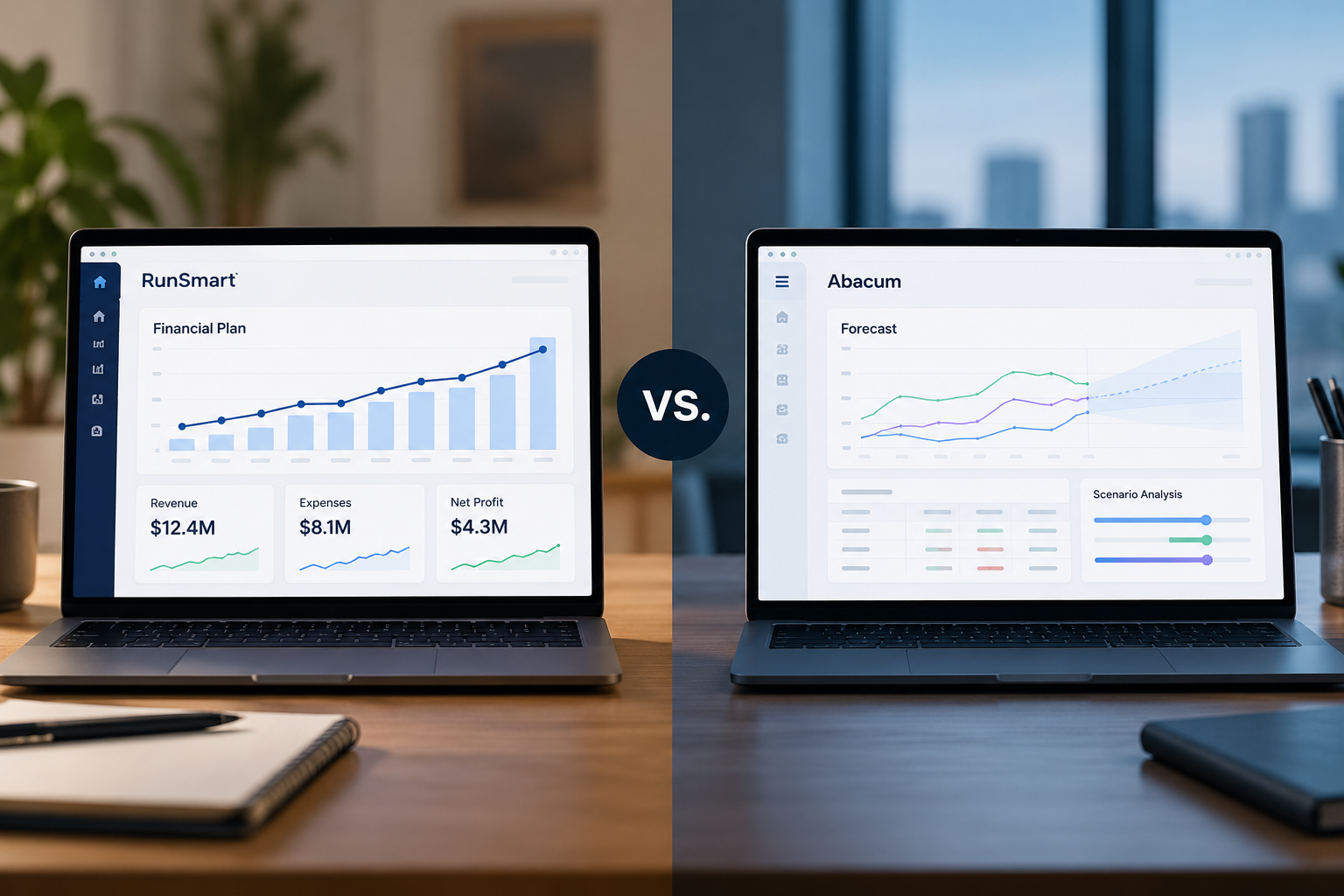
RunSmart vs. Abacum: Financial Planning & Forecasting Compared
RunSmart by Projection Genie and Abacum both help businesses move beyond historical accounting into forecasting, financial planning, scenario analysis, reporting, and forward-looking decision-making.
But they approach financial planning from very different directions.
Abacum is an AI-native business planning platform built around driver-based models, collaborative planning, operational data, reporting, multi-entity planning, and AI agents that help finance teams build and operate the financial-planning environment.
RunSmart focuses more heavily on automatically analyzing financial behavior, evaluating statistical forecasting methods, establishing a starting financial forecast, monitoring financial health, identifying emerging risks, and connecting SaaS subscription activity directly to broader financial outcomes.
For SaaS businesses using Stripe and QuickBooks Online, RunSmart also connects subscription intelligence across:
Historical → Live / MTD → Forecast
The central difference is therefore not simply whether the platforms use AI or whether they can forecast.
Both provide sophisticated planning capabilities.
A more useful distinction is:
Abacum is designed to make finance teams and business-planning workflows increasingly AI-native.
RunSmart is designed to reduce how much traditional FP&A work the user needs to perform before receiving useful financial intelligence.
This comparison examines RunSmart and Abacum across:
- Financial forecasting
- AI
- Financial modeling
- SaaS analytics
- Scenario planning
- Workforce planning
- Reporting
- Data integrations
- Multi-entity planning
- MCP
- Financial health
- Portfolio intelligence
- Pricing
Note: RunSmart's MCP integration is coming soon and is not yet generally available. References to MCP capabilities in this article describe planned functionality that will be available in a future release.
RunSmart vs. Abacum at a Glance
Both platforms can support sophisticated financial planning.
But they are designed around different operating models.
Abacum is especially strong for finance teams that want AI-assisted model building, connected planning, operational and financial data, collaborative workflows, multi-entity planning, reporting, and a broad integration ecosystem.
RunSmart is designed more around automatically producing and interpreting forward-looking financial intelligence so founders, SMBs, advisors, and portfolio users do not have to construct the entire financial model themselves.
What Is RunSmart by Projection Genie?
RunSmart is a financial intelligence, forecasting, and planning platform designed for founders, small and midsize businesses, accounting firms, advisors, and investors.
RunSmart connects to QuickBooks Online and analyzes historical financial information.
Its capabilities include:
- Historical financial analysis
- Automated statistical forecasting
- Integrated financial statement forecasts
- Scenario modeling
- Budgeting
- Budget-versus-actual tracking
- Workforce planning
- Financial-health analysis
- Emerging-risk detection
- Automated financial reporting
- Portfolio-level intelligence
- Collaboration and role-based access
For SaaS businesses, RunSmart can also connect Stripe subscription activity with QuickBooks Online financial information.
This adds subscription intelligence such as:
- MRR
- ARR
- Active Customers
- Customer Growth
- Customer Churn
- New MRR
- Reactivation MRR
- Expansion MRR
- Contraction MRR
- Churned MRR
- Net New MRR
- NRR
- GRR
- SaaS Quick Ratio
- ARPA
- LTV
- Burn Multiple
- Rule of 40
RunSmart organizes this SaaS intelligence into:
Historical: completed-period subscription performance
Live / MTD: current subscription activity using the latest available Stripe information
Forecast: modeled future subscription performance
This connects:
What happened → What is happening now → What may happen next
Does RunSmart Require 24 Months of Financial History?
Not to use RunSmart.
Businesses can use applicable non-forecasting capabilities before reaching 24 months of financial history.
Depending on the plan, these can include:
- Historical QuickBooks analysis
- Historical Stripe analytics
- Live Subscription Performance
- SaaS KPIs
- Financial-health analysis
- Budgeting
- Workforce planning
- Reporting
At least 24 months of historical financial data is required for RunSmart's automated forecasting capabilities.
Once sufficient history exists, RunSmart can analyze financial behavior and establish a forward-looking baseline automatically.
How Does RunSmart Forecast Financial Performance?
RunSmart evaluates multiple statistical forecasting approaches instead of applying the same method to every financial series.
Supported methods can include:
- Holt-Winters
- Holt linear trend
- Simple exponential smoothing
- ARIMA
- Theta
- Drift
- Mean
- Naive
- Seasonal Naive
- Croston
- Trend and seasonal regression approaches
Different financial accounts can behave differently.
Revenue may contain:
- Growth
- Seasonality
- Volatility
- Changing trends
Payroll may follow a relatively stable progression.
Rent may remain nearly flat.
Marketing expenses may fluctuate substantially.
Some accounts may contain intermittent activity.
RunSmart evaluates historical predictive performance to determine which supported forecasting approach is most appropriate for each financial series.
The user does not have to begin by deciding which statistical methodology belongs on each account.
RunSmart establishes the starting forecast first.
Users can then modify assumptions involving:
- Revenue
- Pricing
- Subscriber growth
- Churn
- Expansion
- Contraction
- Hiring
- Compensation
- Marketing
- Operating expenses
- Financing
- Other business drivers
Those changes can affect projected:
- Revenue
- Expenses
- Profitability
- Cash flow
- Cash balances
- Financial statements
- Financial health
- Runway
What Is Abacum?
Abacum is an AI-native business planning platform designed primarily for finance teams and increasingly for broader cross-functional planning.
Its capabilities include:
- Financial planning
- Budgeting
- Forecasting
- Driver-based modeling
- Scenario planning
- Workforce planning
- Reporting
- Operational planning
- Data transformation
- Multi-entity rollups
- Collaborative planning
- AI-assisted analysis
- AI-assisted model creation
- Business-wide planning workflows
Abacum connects financial and operational information into one governed planning environment containing:
- Data
- Business logic
- Models
- Assumptions
- Plans
- Business context
Finance remains at the center of the platform, but Abacum increasingly positions the product as a broader business-planning environment rather than only an FP&A application.
What Is Abra?
Abra is Abacum's unified AI agent for business planning.
Rather than asking users to choose a specific AI tool or workflow for each question, Abra interprets the request and coordinates specialized agents behind the scenes.
For example, a user could ask:
What would it take to reach $50 million in ARR next year?
Abra can determine which planning tasks are required and route the work to the appropriate specialized agents.
The current agent architecture includes:
- Modeler
- Analyst
- Reporter
- Data Manager
This makes AI a central operating layer inside Abacum rather than simply a chatbot attached to the product.
What Does Abacum Modeler Do?
Modeler helps users build, explain, edit, and review financial and operational models using natural language.
A finance user can describe the model they want instead of manually creating every variable and formula.
For example, a user could ask Abacum to:
- Build a P&L model from connected general-ledger data
- Add a marketing-spend driver
- Create a headcount model
- Break costs down by channel
- Explain how a particular number is calculated
- Modify an existing model
Modeler can also start from an existing spreadsheet or from curated modeling blueprints.
This significantly lowers the technical barrier to building driver-based financial models.
Importantly, Modeler does not perform financial calculations through a separate generative-AI arithmetic path.
Abacum's calculation engine still performs the actual calculations.
AI proposes the model structure and changes, while users approve modifications before they are applied.
What Does Abacum Analyst Do?
Analyst is focused on understanding financial performance.
Users can ask questions such as:
- Why did gross margin decline?
- What drove the revenue variance?
- Which expenses exceeded plan?
- Why did cash flow deteriorate?
- What changed relative to the prior forecast?
Analyst can investigate the underlying data and financial drivers and provide explanations grounded in the company's planning environment.
This makes Abacum particularly useful for finance teams that want AI to assist with recurring variance analysis and financial investigation.
What Does Abacum Reporter Do?
Reporter helps create and update reporting outputs.
It can work with:
- Reports
- Slides
- Tables
- Charts
- Abacum Spaces
- Executive presentations
This can accelerate recurring management and board-reporting workflows.
Rather than simply generating written commentary, Reporter works with the underlying governed financial and operational information inside Abacum.
What Does Abacum Data Manager Do?
Data Manager helps prepare information for financial planning.
Its responsibilities can include:
- Transforming spreadsheet information
- Creating structured datasets
- Building input tables
- Creating plan versions
- Updating planning values
This helps finance teams spend less time manually cleaning and restructuring data before they can use it inside planning models.
How Is Abacum's AI Architecture Different From RunSmart?
Both platforms distinguish between AI interaction and underlying financial calculations.
But they use that separation very differently.
Abacum
Abacum uses AI agents to help users:
- Build financial models
- Modify models
- Analyze variances
- Transform data
- Create scenarios
- Prepare reports
- Update planning values
The actual financial calculations continue to run through Abacum's deterministic calculation engine.
Users approve proposed changes before those changes are saved.
RunSmart
RunSmart uses statistical and deterministic financial engines to calculate:
- Forecasts
- Financial statements
- SaaS metrics
- Financial-health scores
- Emerging-risk signals
- Scenario results
- Portfolio metrics
AI is then used as an interaction layer over that calculated intelligence through MCP.
The distinction can be summarized as:
Abacum uses AI to help finance teams build and operate the planning environment.
RunSmart uses its financial engine to establish the intelligence first, then allows AI to help users interact with the results.
What Is the Biggest Difference Between RunSmart and Abacum?
The largest difference is how much model construction the user is expected to perform.
Abacum increasingly makes model construction easier through AI.
A finance user can describe the desired model in natural language and allow Modeler to create much of the structure automatically.
That significantly reduces the amount of formula writing and technical configuration traditionally required in FP&A software.
However, the organization is still defining the planning model.
Users determine:
- Which drivers matter
- How the business should be modeled
- Which operational relationships should be represented
- Which scenarios should exist
- How planning dimensions should be structured
RunSmart takes a different approach.
For the baseline financial forecast, users generally do not need to define the statistical model at all.
RunSmart automatically:
- Analyzes historical behavior
- Evaluates multiple forecasting approaches
- Determines an appropriate model
- Establishes the financial baseline
- Produces projected financial statements
Users then modify assumptions and evaluate decisions around that starting point.
A simplified distinction is:
Abacum: Tell the system how you want the business modeled, with AI helping build and operate that model.
RunSmart: Connect the financial data and let RunSmart determine the statistical baseline automatically before you begin scenario planning.
Which Platform Is Better for Financial Forecasting?
Both provide substantial forecasting capabilities.
The difference is the methodology and workflow.
RunSmart
RunSmart focuses on automatically evaluating historical financial behavior and selecting among multiple statistical forecasting methods.
This is useful when the user wants the system to determine the most appropriate baseline based on historical predictive performance.
Abacum
Abacum focuses more heavily on flexible driver-based business planning.
Finance teams can model future performance using operational assumptions such as:
- Customers
- Sales pipeline
- Pricing
- Headcount
- Marketing
- Capacity
- Units
- Conversion rates
- Department expenses
- Business-specific drivers
AI Modeler can now help create these models directly from natural-language instructions.
The choice therefore depends on whether the organization prefers:
Automated statistical baseline forecasting
or:
AI-assisted construction of a highly configurable driver-based planning model
Which Platform Is Better for Scenario Planning?
Both platforms provide scenario analysis.
Abacum has the advantage in flexible business-model construction.
Finance teams can build different scenarios around:
- Revenue
- Pipeline
- Pricing
- Headcount
- Department spending
- Operational assumptions
- Business units
- Entities
- Other company-specific drivers
AI can also help construct and modify those scenarios.
RunSmart provides scenario planning around the automatically established financial baseline.
Users can modify assumptions involving:
- Revenue
- Pricing
- Subscriber growth
- Churn
- Expansion
- Contraction
- Hiring
- Compensation
- Operating expenses
- Financing
Those changes can flow through projected:
- Revenue
- Profitability
- Cash flow
- Cash
- Financial statements
- Financial health
- Runway
For teams that want highly customized driver-based models, Abacum provides greater flexibility.
For users who want to begin with an automatically established financial outlook, RunSmart requires less upfront model construction.
Which Platform Is Better for SaaS Companies?
Both can support SaaS businesses.
Abacum can connect financial and operational information from systems such as:
- Accounting platforms
- CRMs
- Billing systems
- Data warehouses
- HR systems
Finance teams can then build SaaS planning models around metrics such as:
- ARR
- MRR
- Customers
- Pipeline
- Churn
- Expansion
- Pricing
- Headcount
- CAC
Stripe is among Abacum's supported integration ecosystem.
RunSmart takes a more purpose-built approach for SaaS businesses using Stripe and QuickBooks Online.
The subscription workflow is already defined inside the platform rather than requiring the finance team to construct it from general-purpose operational data.
Historical, Live, and Forecast SaaS Intelligence in RunSmart
RunSmart organizes Stripe subscription intelligence into:
Historical Actuals → Live / MTD → Forecast
Historical Subscription Performance
Completed historical months can include SaaS KPIs such as:
- MRR
- ARR
- Active Customers
- Customer Growth
- MRR Growth
- ARR Growth
- Customer Churn
- NRR
- GRR
- Net New MRR
- SaaS Quick Ratio
- ARPA
- LTV
- Burn Multiple
- Rule of 40
RunSmart also separates recurring-revenue movements into:
- New MRR
- Reactivation MRR
- Expansion MRR
- Contraction MRR
- Churned MRR
A simplified recurring revenue bridge is:
Ending MRR = Beginning MRR + New MRR + Reactivation MRR + Expansion MRR - Contraction MRR - Churned MRR
This helps explain not simply whether MRR changed, but why.
Live Subscription Performance
RunSmart also provides a separate view of current-month Stripe activity using the latest available data.
Current point-in-time measures can include:
- MRR
- ARR
- Active Customers
- ARPA
Month-to-date subscription activity can include:
- New MRR
- Reactivation MRR
- Expansion MRR
- Contraction MRR
- Churned MRR
- Net New MRR
- New Customers
- Reactivated Customers
- Churned Customers
Keeping the current month separate prevents an incomplete period from distorting completed historical trends.
Subscription Forecasting
Once sufficient history exists, RunSmart can forecast future subscription activity.
Users can modify assumptions involving:
- Pricing
- Subscriber growth
- Churn
- Expansion
- Contraction
- Collections
Those assumptions can change future:
- Subscribers
- MRR
- ARR
- Billings
- Recognized Revenue
- Cash Collected
The resulting subscription forecast connects directly to the broader company financial model.
How Does RunSmart Connect SaaS Metrics to Financial Statements?
Subscription metrics and accounting metrics are not interchangeable.
RunSmart distinguishes among:
- MRR
- Net Billings
- Recognized Revenue
- Cash Collected
- Deferred Revenue
- Accounts Receivable
MRR represents normalized recurring subscription value.
Net Billings reflects invoiced subscription activity after applicable credits.
Recognized Revenue reflects subscription revenue associated with the appropriate service period.
Cash Collected represents actual or forecast customer payments.
For accrual-basis QuickBooks projects, Recognized Revenue can flow into the forecasted P&L while Accounts Receivable and Deferred Revenue affect the broader financial model.
For cash-basis projects, Cash Collected drives subscription revenue.
This creates a connected flow:
Subscribers → MRR → Billings → Revenue / Cash → Financial Statements → Profitability → Cash → Runway
Abacum can also construct sophisticated SaaS models through its driver-based planning environment.
RunSmart's distinction is that much of this Stripe-specific logic is already built into the workflow.
Which Platform Is Better for Workforce Planning?
Both platforms support workforce planning.
Abacum
Abacum can combine HR, payroll, and operational information with financial planning.
Finance teams can model:
- Existing headcount
- Future hires
- Compensation
- Departments
- Hiring timing
- Workforce costs
- Business-specific workforce drivers
Because Abacum supports broader connected planning, workforce assumptions can interact with department, entity, revenue, and operational models.
RunSmart
RunSmart includes a dedicated Workforce Planner.
Users can model:
- Existing roles
- Planned hires
- Compensation
- Payroll taxes
- Benefits
- Raises
- Start dates
- End dates
Workforce costs can be mapped directly into forecastable P&L accounts, including:
- Cost of Goods Sold
- Operating Expenses
Customized workforce costs can then flow into the financial forecast.
The distinction is:
Abacum provides greater flexibility for workforce planning inside a broader business-planning model.
RunSmart provides a more structured workforce-planning workflow directly connected to its automated financial forecast.
Which Platform Is Better for Financial Reporting?
Abacum has the advantage in highly configurable financial and management reporting.
Its reporting environment can support:
- Reports
- Dashboards
- Tables
- Charts
- Executive presentations
- Slides
- Management reporting
- Investor reporting
- Abacum Spaces
Reporter can also help generate and update these outputs through AI.
RunSmart provides:
- Financial statements
- Automated recurring reports
- Forecast views
- KPI reporting
- Financial-health analysis
- Emerging-risk intelligence
- Portfolio views
RunSmart does not provide the same type of traditional custom report-building environment.
Its emphasis is more heavily on automatically calculating and surfacing the underlying financial intelligence.
For highly customized financial and management reporting, Abacum has the advantage.
Which Platform Is Better for Financial Health Analysis?
RunSmart provides a dedicated Business Health Scorecard.
It evaluates:
- Profitability
- Liquidity
- Solvency
- Efficiency
- Capitalization
The scorecard combines 13 financial KPIs into an overall financial-health assessment.
RunSmart also monitors for emerging risks involving areas such as:
- Cash insolvency
- Debt-service coverage
- Interest coverage
- Sustained losses
- Rapid cash deterioration
- Revenue contraction
- Sustained revenue downtrends
- Margin compression
- Liquidity weakening
- Leverage expansion
This framework is designed to automatically surface financial conditions that may require attention.
Abacum provides sophisticated analysis through:
- KPIs
- Variance analysis
- Financial models
- Reporting
- Analyst
- Scenario planning
Abacum users can investigate financial performance deeply.
RunSmart's distinction is that health and emerging risk are predefined financial-intelligence layers rather than analyses the finance team must first configure.
Which Platform Has More Integrations?
Abacum has a significant advantage in integration breadth.
Abacum currently promotes more than 700 integrations across financial and operational systems.
Examples include categories such as:
- ERP
- Accounting
- CRM
- Billing
- HRIS
- Payroll
- Data warehouses
- Business intelligence
- Databases
- Spreadsheets
Its current ecosystem includes systems such as:
- Stripe
- Salesforce
- Snowflake
- Tableau
- Looker
- Amazon S3
Abacum also emphasizes self-service data transformation so finance teams can work with connected information without relying as heavily on consultants or technical support.
RunSmart currently uses QuickBooks Online as its core financial foundation and provides deeper purpose-built integrations such as Stripe.
The distinction is:
Abacum: broad connectivity for a configurable business-planning environment.
RunSmart: fewer integrations with deeper prebuilt workflows around specific financial-intelligence use cases.
Which Platform Is Better for Multi-Entity Planning?
Abacum has the advantage.
Its business-planning environment supports multi-entity financial structures, rollups, and related planning use cases.
This makes Abacum more appropriate for organizations that need to plan across:
- Multiple legal entities
- Business units
- Departments
- Geographies
- Other organizational dimensions
RunSmart treats separate businesses as separate projects.
Its Portfolio View is designed to compare those independent businesses rather than consolidate them into one combined financial model.
The distinction is:
Abacum helps finance teams plan and roll up complex organizational structures.
RunSmart helps advisors, operators, and investors compare financial intelligence across separate businesses.
Which Platform Is Better for Portfolio Intelligence?
RunSmart has the stronger dedicated cross-company portfolio experience.
Its Portfolio View can surface:
- Revenue
- Net Income
- Net Margin
- Cash
- Financial Health Grade
- Emerging Risks
For Stripe-connected SaaS businesses, users can also compare:
- MRR
- Active Subscribers
- NRR
This helps accounting firms, advisors, and investors answer questions such as:
- Which businesses have weakening liquidity?
- Which companies have declining margins?
- Which companies have emerging cash risks?
- Which SaaS companies have deteriorating NRR?
- Which businesses should be reviewed first?
Abacum is stronger when the goal is planning across departments, entities, and operating units inside the same organizational environment.
RunSmart is more explicitly designed to compare independent companies.
Which Platform Is Better for Finance Teams?
Abacum is likely the stronger fit for an established finance or FP&A organization.
Its capabilities are designed for teams that need:
- Driver-based financial models
- Operational planning
- Multiple planning dimensions
- Collaborative workflows
- Broad data connectivity
- Custom reporting
- Multi-entity planning
- AI-assisted model building
- Variance analysis
- Cross-functional planning
Abra and Modeler also reduce the technical barrier to building and maintaining those models.
RunSmart can support finance professionals, but its core product philosophy is different.
It is designed to automate more of the underlying financial analysis so a company does not need to establish a sophisticated FP&A process before receiving meaningful forward-looking intelligence.
Which Platform Is Better for Founders?
RunSmart is more directly designed around founders and smaller organizations that may not have a dedicated FP&A team.
A founder may want answers to questions such as:
- Where is revenue heading?
- What happens if growth slows?
- Can we afford another employee?
- What happens if churn increases?
- How could a pricing change affect cash flow?
- Is financial health weakening?
- How much runway could remain?
RunSmart is designed to answer those questions without requiring the founder to first build a detailed driver-based financial-planning model.
Abacum has made model creation dramatically easier through Modeler and Abra.
But it remains fundamentally a business-planning environment where the organization defines and manages the planning model.
Which Platform Is Better for Accounting Firms and Advisors?
Both can support advisory use cases, but their strengths differ.
Abacum can give finance professionals highly flexible planning, reporting, modeling, and collaboration capabilities.
This may be especially valuable for sophisticated outsourced CFO and FP&A engagements.
RunSmart is designed to automate more of the analysis across standardized client projects.
Its Portfolio View can help firms identify which clients may deserve attention based on:
- Financial performance
- Financial health
- Emerging risks
- Cash
- Margins
- SaaS performance
This creates a more exception-based advisory workflow.
Instead of manually reviewing every client simply to determine whether something has changed, the advisor can use portfolio-level intelligence to prioritize deeper analysis.
How Does MCP Compare?
Both platforms are increasingly designed to allow financial information to be accessed through external AI systems.
Abacum
Abacum's AI architecture already operates deeply inside the planning platform through Abra and its specialized agents.
Abacum also supports MCP-based access to governed financial information from compatible AI environments.
The broader architecture can give AI access to:
- Financial models
- Planning information
- Business context
- Data
- Reports
- Scenario information
while preserving underlying permissions.
This fits Abacum's broader objective of making planning workflows increasingly agentic.
RunSmart
RunSmart's MCP is designed around exposing calculated financial intelligence.
That can include:
- Historical financial information
- Forecasts
- Scenario results
- SaaS metrics
- Financial health
- Emerging risks
- Portfolio information
For example, a user could ask:
Which companies have the weakest forecast liquidity?
Compare the Base and Bear scenarios for this business.
Which SaaS companies have declining NRR?
Summarize the most important financial risks across this portfolio.
The distinction is consistent with the broader product philosophies.
Abacum uses AI as an active participant in building and operating the planning environment.
RunSmart uses AI as a way to interact with financial intelligence calculated by the RunSmart engine.
How Much Does RunSmart Cost?
RunSmart has three single-project plans:
- Standard — $99/month
- Premium — $299/month
- Pro — $499/month
Stripe subscription intelligence is available across all three plans.
Standard
Standard provides:
- Historical financial analysis
- Historical Stripe analytics
- Live Subscription Performance
- Applicable non-forecasting capabilities
It does not include automated forecasting.
Premium
Premium adds:
12-month automated financial and subscription forecasting
for businesses that meet the historical-data requirements.
Pro
Pro extends automated forecasting to:
Up to five years
and adds deeper planning, collaboration, integrations, and advanced capabilities.
For Pro multi-project purchases, projects are sold in bundles of:
- 5
- 10
- 15
- 20
- Additional multiples of five
All projects in those bundles cost:
$249/project/month
including the first project.
Annual billing receives a 10% discount.
How Much Does Abacum Cost?
Abacum does not publish standard self-service prices.
Organizations need to request a quote based on requirements such as:
- Company complexity
- Planning requirements
- Users
- Data integrations
- Entities
- Reporting
- Implementation needs
Third-party procurement data has previously reported Abacum contract values substantially above RunSmart's single-project pricing.
However, third-party purchasing benchmarks should not be treated as Abacum-published pricing.
Actual Abacum quotes can vary depending on company requirements and implementation scope.
RunSmart, by comparison, publishes its monthly pricing directly.
Which Platform Is More Affordable?
RunSmart has the much lower published entry point.
RunSmart Standard costs:
$99/month
Premium costs:
$299/month
Pro costs:
$499/month
Abacum uses customized quote-based pricing.
But the platforms also address different levels of planning complexity.
Abacum provides capabilities such as:
- AI-assisted model building
- Multi-entity planning
- Broad integrations
- Driver-based models
- Custom reporting
- Cross-functional planning
- Collaborative planning
- AI agents embedded throughout planning workflows
For an established finance organization building a sophisticated business-planning infrastructure, that additional capability may justify a significantly higher investment.
For a founder or smaller organization that wants automated forecasting and financial intelligence without implementing a broader FP&A environment, RunSmart represents a different price category.
When Is Abacum Better Than RunSmart?
Abacum may be the better choice when the organization needs:
- AI-assisted financial-model construction
- Driver-based planning
- Multi-entity planning
- Cross-functional planning
- Large integration breadth
- Custom reporting
- Operational modeling
- Collaborative planning workflows
- Complex scenario planning
- Extensive data transformation
- AI agents embedded throughout planning
- Finance-team-driven business planning
Abacum is particularly compelling when the company already has a finance function and wants AI to make that team dramatically more productive.
When Is RunSmart Better Than Abacum?
RunSmart may be the better choice when the organization wants:
- Automated statistical forecasting
- Automated model selection
- Less manual financial-model construction
- Financial-health scoring
- Emerging-risk detection
- Integrated QuickBooks and Stripe intelligence
- Historical, live, and forecast SaaS analytics
- Subscription forecasting
- Workforce planning
- Portfolio-level financial intelligence
- Transparent monthly pricing
RunSmart is particularly relevant when the organization wants sophisticated forward-looking financial intelligence without first implementing a traditional FP&A planning environment.
RunSmart vs. Abacum: Which Should You Choose?
Choose Abacum if your priority is:
- Building sophisticated driver-based financial models
- Using AI to build and modify those models
- Multi-entity planning
- Broad business-system integrations
- Collaborative planning
- Operational modeling
- Custom reporting
- Cross-functional business planning
- AI agents that participate deeply throughout the planning process
Choose RunSmart if your priority is:
- Automatically establishing the financial baseline
- Statistical model selection
- Reducing financial-model construction
- Financial-health interpretation
- Emerging-risk detection
- Purpose-built Stripe and QuickBooks intelligence
- Live SaaS monitoring
- Subscription forecasting
- Workforce planning
- Portfolio-level financial intelligence
- Lower-friction financial planning
The platforms overlap substantially in planning capability.
But they are solving different workflow problems.
Abacum is trying to make the finance team and business-planning process AI-native.
RunSmart is trying to reduce how much traditional FP&A work is required before the business can understand where it may be heading.
RunSmart vs. Abacum: Final Comparison
Abacum and RunSmart both represent a move beyond spreadsheet-only financial planning.
But they begin from different assumptions.
Abacum begins with the planning organization.
Its strengths include:
- AI-assisted model building
- Driver-based planning
- Multi-entity planning
- Broad integrations
- Reporting
- Collaborative planning
- Operational modeling
- Specialized AI agents
Abra coordinates those capabilities across Modeler, Analyst, Reporter, and Data Manager so finance teams can use AI throughout the planning process.
RunSmart begins with financial intelligence.
Its strengths include:
- Automated statistical forecasting
- Automatic model selection
- Financial-health analysis
- Emerging-risk detection
- SaaS subscription intelligence
- Historical, live, and forecast analysis
- Workforce planning
- Portfolio prioritization
For a mature finance team that wants AI to help build, operate, and scale a highly customized financial-planning environment, Abacum may be the stronger fit.
For a founder, advisor, or smaller finance organization that wants the platform to automatically perform more of the forecasting and financial interpretation before the user begins planning, RunSmart takes a different approach.
For SaaS businesses using Stripe and QuickBooks Online, RunSmart also provides a specialized workflow:
Historical subscription performance → Live current activity → Future subscription forecasts → Company-wide financial outcomes
Ultimately, the choice depends on what you want AI and financial software to do.
If you want:
AI agents that help your finance team build and operate sophisticated business-planning models
Abacum is designed around that process.
If you want:
A financial intelligence platform that automatically analyzes historical behavior, determines forecasting approaches, establishes forecasts, evaluates health and risk, and lets you test decisions around that baseline
RunSmart is designed around that process.
Frequently Asked Questions
What is the main difference between RunSmart and Abacum?
Abacum is an AI-native business-planning platform focused on driver-based models, AI-assisted planning, multi-entity planning, reporting, operational data, and collaborative finance workflows.
RunSmart focuses more heavily on automated statistical forecasting, financial-health analysis, emerging risks, SaaS subscription intelligence, workforce planning, and portfolio-level financial intelligence.
What is Abra?
Abra is Abacum's unified AI agent.
It interprets user requests and coordinates specialized agents such as Modeler, Analyst, Reporter, and Data Manager to perform planning, modeling, analysis, reporting, and data-preparation tasks.
Does Abacum use AI to perform financial calculations?
Abacum's AI agents can propose models, formulas, analyses, and changes, but its deterministic calculation engine performs the underlying calculations.
Users review and approve proposed model changes before they are saved.
What does Abacum Modeler do?
Modeler can build, explain, edit, and review financial and operational models from natural-language instructions or existing spreadsheet information.
It allows finance teams to create driver-based models without requiring every user to learn a proprietary modeling language first.
Does RunSmart use generative AI to create forecasts?
No.
RunSmart calculates its underlying forecasts using statistical forecasting approaches and deterministic financial logic.
AI can interact with the resulting financial intelligence through MCP, but it does not determine the underlying financial calculations.
What forecasting methods does RunSmart use?
RunSmart can evaluate multiple forecasting approaches, including:
- Holt-Winters
- Holt linear trend
- Simple exponential smoothing
- ARIMA
- Theta
- Drift
- Mean
- Naive
- Seasonal Naive
- Croston
- Trend and seasonal regression approaches
RunSmart evaluates historical predictive performance to determine which supported method is most appropriate for individual financial series.
Does RunSmart require 24 months of financial history?
RunSmart requires at least 24 months of financial history for automated forecasting.
Businesses with less history can still use applicable non-forecasting capabilities such as historical analysis, live Stripe analytics, SaaS KPIs, financial-health analysis, budgeting, workforce planning, and reporting depending on the selected plan.
Does RunSmart provide live Stripe analytics?
Yes.
RunSmart's Live Subscription Performance view can include current measures such as:
- MRR
- ARR
- Active Customers
- ARPA
and month-to-date activity such as:
- New MRR
- Reactivation MRR
- Expansion MRR
- Contraction MRR
- Churned MRR
- Net New MRR
Which platform is better for SaaS businesses?
Both can support SaaS planning.
Abacum allows finance teams to build sophisticated SaaS models using connected accounting, billing, CRM, workforce, and operational information.
RunSmart provides a more purpose-built Stripe and QuickBooks Online workflow with historical, live, and forecast subscription intelligence connected directly to broader financial forecasting.
Which platform has more integrations?
Abacum.
Abacum currently promotes more than 700 integrations across accounting, CRM, billing, HR, data warehouses, analytics, and other business systems.
RunSmart currently uses a smaller integration ecosystem centered on deeper purpose-built workflows.
Which platform is better for multi-entity planning?
Abacum.
Abacum supports multi-entity financial planning and rollups within its broader business-planning environment.
RunSmart treats separate businesses as individual projects and uses Portfolio View to compare financial performance, health, risks, and SaaS metrics across them.
Which platform is better for financial reporting?
Abacum provides greater customization for reports, charts, tables, presentations, and management-reporting workflows.
RunSmart focuses more on standardized automated reports, financial statements, health analysis, risks, forecast views, and portfolio intelligence.
Which platform is better for an established FP&A team?
Abacum may be the stronger fit for an established finance organization that needs:
- Driver-based modeling
- Multi-entity planning
- Broad integrations
- Operational planning
- Custom reporting
- Cross-functional collaboration
- AI-assisted model building
- AI-assisted analysis and reporting
RunSmart is more focused on reducing the amount of model construction required from the user.
Which platform is better for businesses without an FP&A team?
RunSmart may be the better fit when the business wants more of the forecasting methodology and financial interpretation automated.
Abacum has made sophisticated model creation much easier through Abra and Modeler, but its greatest strengths are still centered around building and operating a broader planning environment.
How much does RunSmart cost?
RunSmart Standard costs $99 per month.
Premium costs $299 per month.
Pro costs $499 per month for one project.
For Pro multi-project purchases, bundles of 5, 10, 15, 20, or additional multiples of five cost $249 per project per month.
Annual billing receives a 10% discount.
How much does Abacum cost?
Abacum does not publish standardized self-service pricing.
Organizations need to request a quote based on their planning, integration, user, entity, and implementation requirements.
Which platform is cheaper?
RunSmart has a substantially lower published entry price.
Abacum is positioned as a broader AI-native business-planning platform for finance teams and uses custom pricing.
The more important comparison is whether the organization needs Abacum's highly configurable, AI-assisted planning infrastructure or RunSmart's more automated financial-intelligence workflow.

